Best Cut Down Duck Call by Barrel Length and Reed

Six cut down duck calls ranked by what actually decides them: barrel geometry, reed count and body material. The Cut Down 2.0 leads, with a champion-tuned acrylic and a big-barrel budget option close behind.

By Mckinley BirdUpdated 17 min read
On this page
- Best cut down duck call at a glance
- How I screened these six listings
- What actually makes a cut down duck call different?
- 1. Duck Commander unisex adult Polycarbonate Cut Down 2 0 — Best overall
- 2. Elite Duck Calls Murder Acrylic Duck Call — Best premium
- 3. Haydel's Game Calls Inc. Haydels Game Calls Big Barrelled — Best budget pick
- 4. Power Calls Mallard Duck Call — Best for heavy use
- 5. Duck Commander CDTimber Duck Call — Best for families
- 6. Elite Duck Calls Polycarbonate Freak — Most versatile
- Single reed or double reed: which should you buy first?
- Polycarbonate, acrylic or a blend?
- What the listings don't tell you
- The verdict
- FAQ
The best cut down duck call is the Duck Commander Cut Down 2.0, a 2.24 oz polycarbonate double reed built on Phil Robertson's original design and re-engineered to take less air pressure. If you want acrylic and a champion's tuning instead, the Elite Duck Calls Murder is the better buy. Most guides rank these calls by loudness, and loudness is the one thing every cut down already has. What separates them is how much air pressure the barrel demands before it breaks over into a bark.
Best cut down duck call at a glance
| Pick | Reed | Body / weight | Price |
|---|---|---|---|
Best overall Duck Commander Cut Down 2.0 |
Double | Polycarbonate 2.24 oz |
Check Price |
Best premium Elite Duck Calls Murder |
Single or double | Acrylic Black Cherry Pearl |
Check Price |
Best budget pick Haydel's Big Barrelled Cutdown |
Mallard hen tuning | Acrylic bottom 2 x 8 x 5.5 in |
Check Price |
Best for heavy use Power Calls Ignition |
Single, Mylar | Poly/acrylic blend 2.4 oz |
Check Price |
Best for families Duck Commander CD Timber |
Double, friction fit | Realtree Timber wrap 2.4 oz |
Check Price |
Most versatile Elite Duck Calls Freak / Edge |
Single or double | Polycarbonate Black |
Check Price |



How I screened these six listings
I started from the Game Calls > Duck category and pulled every listing that names a cut down or cutdown design in its own title or feature copy. That filter matters. Plenty of short-barrel calls get marketed as "cut down style" without the geometry behind the name, and I didn't want a standard mallard call wearing borrowed vocabulary.
From there I compared the published specifications side by side: reed count, body material, weight, dimensions, warranty and model number. Six listings survived with enough published detail to compare honestly.
What I cut, and why:
- Listings with no reed count stated. Reed count is the single biggest predictor of how a call behaves in your hands.
- Calls with no body material named. Acrylic and polycarbonate sound different, and a listing that hides it isn't giving you enough to decide.
- Duplicate variants of a call already in the set, so one entry covers each family.
One honest limitation up front. Amazon's search treats "cut down" loosely, and two of these six describe themselves in cut down terms without publishing barrel measurements. Where I couldn't confirm the geometry from the listing, I've said so in that product's section rather than filling the gap with a guess.
What actually makes a cut down duck call different?
A cut down duck call is a mallard call whose barrel has been shortened, which raises the air pressure inside the call before the sound ever reaches the reed. That pressure is the whole point. It's what lets a good caller snap out a hard bark, then drop straight into a soft feed chuckle without swapping calls.
Here's the trick with the category. The shortened barrel doesn't just make the call louder. It makes the call less forgiving. A standard call spreads your air over a longer tube and smooths out inconsistency. Cut it down and every wobble in your breath support shows up in the note.
So the real deciding criterion isn't volume. It's the pressure threshold: how hard you have to push before the call breaks into its top register.
Three things move that threshold on these six listings:
- Barrel geometry. The Cut Down 2.0 and the Murder both advertise a short profile. Haydel's goes the other way with a large barrel that admits more air for volume.
- Reed count. A double reed adds resistance and softens your mistakes. A single reed gives you sharper control and punishes you for sloppy air.
- Insert design. Power Calls names a keyhole insert built for aggressive barks. Duck Commander describes a friction fit that holds its tune.
Most shoppers miss the second and third of those entirely and buy on the barrel photo. Match the threshold to your lungs and your experience, and the best cut down duck call for you will usually be obvious.
1. Duck Commander unisex adult Polycarbonate Cut Down 2 0 — Best overall
The Cut Down 2.0 is the best cut down duck call here because it carries the original design's power while asking for noticeably less air pressure than the call it replaced.
Best for: an intermediate caller who wants the classic cut down sound with a shorter learning curve Skip it if: you've never blown a duck call before
This is the most completely documented listing in the set, and that counts for something. You get a weight of 2.24 oz, packaged dimensions of 5 x 7.75 x 1.5 in, model DCCD, and a stated single-unit count. Nothing else here publishes that much.
Duck Commander describes it as a rebuild of Phil Robertson's cut down, with a short barrel that creates built-in pressure and, in the brand's own words, an updated design that's easier to blow than the original while keeping the range. The listing also claims it excels at feed calls, which tracks with the double reed: two reeds give you the raspy, layered chuckle that a single reed has to work harder to fake.
It's also the one buyers choose most often out of these six, and the second-cheapest of the lot. That combination is unusual in this category, where the short-barrel builds normally sit at the top of the price ladder.
The trade-off is material. Polycarbonate doesn't carry the bright, cutting edge of acrylic, so the Murder and Haydel's both have a sharper ceiling. And the brand's own copy admits this call needs more skill and control than a standard one.
Pros:
- Most complete published specifications in this set
- Verified 2.24 oz weight, light on a lanyard
- Double reed suits feed calls and chuckles
- Second-cheapest of the six picks
- The fastest seller of this group
Cons:
- Polycarbonate lacks acrylic's brightness
- No warranty stated on the listing
- Brand admits it demands more skill than a standard call
- Only one seller lists it
2. Elite Duck Calls Murder Acrylic Duck Call — Best premium
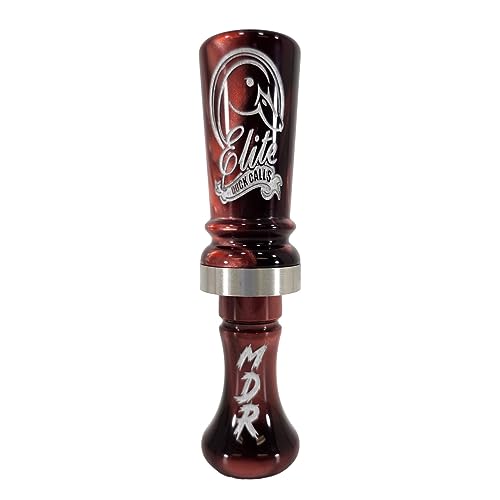
The Murder is the acrylic option in this group, sold in either single or double reed, and it's the pick for a caller who's already comfortable running a short barrel.
Best for: a caller who already runs a cut down well and wants an acrylic upgrade Skip it if: you're still deciding whether cut down calls suit you
Acrylic is the reason this is the most expensive pick here. It's a denser, harder material than polycarbonate, and it's what competition callers reach for when they want a note with edge on it. The finish is Black Cherry Pearl, and there's a manufacturer warranty on the listing, which only three of these six publish at all.
Elite names Brad Allen, a three-time world champion, as the designer and tuner. Take that as what it is: a credential on the box, not a measurement. What's more useful is the reed choice. Buying the same call in single or double reed means you pick your own pressure threshold rather than accepting the maker's. Elite describes the single as responsive and the double as easier to use, which is the standard trade and an honest way to put it.
Two feature claims are worth noting. Elite says the short profile improves airflow efficiency, and that moisture channels help clear blockages in wet or cold weather.
The catch is documentation. No weight, no dimensions, no model number. And it's the slowest-moving pick of the six by a wide margin, so you're buying on the maker's word rather than on any signal from other hunters.
Pros:
- Only acrylic-bodied call in this set
- Choice of single or double reed at purchase
- Manufacturer warranty published
- Moisture channels claimed for wet-weather use
Cons:
- Most expensive pick here
- No published weight, size or model number
- Slowest seller of the six
- Champion tuning is a credential, not a verified spec
3. Haydel's Game Calls Inc. Haydels Game Calls Big Barrelled — Best budget pick
Haydel's takes the opposite approach to every other pick here, using a large barrel to move volume, and it's the cheapest call in the group.
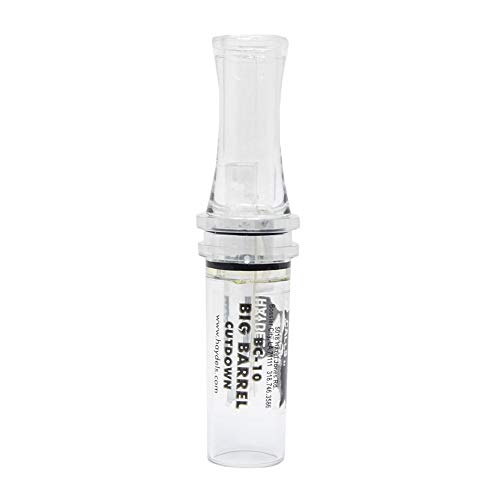
Best for: open-water hunters who need raw volume on a small budget Skip it if: you hunt tight timber and need soft finesse notes
Read the name carefully. Big Barrelled Cutdown is a deliberate contradiction, and Haydel's is upfront about the logic: the large barrel design lets in more air for a loud call. That's a different route to reach across a flooded field than the short-barrel pressure trick, and it usually means less back pressure resisting your breath.
The published detail is decent. Clear finish, one size, single unit, a listed weight of 1 lb, packaged dimensions of 2 x 8 x 5.5 in, model BC-10 and a 30 day warranty. Note that the 1 lb figure almost certainly reflects the packaged shipping weight rather than the call on your lanyard, since no duck call weighs a pound.
Haydel's says the tuning is aggressive, that the acrylic bottom sharpens the sound, and that the call has a proven ability to blow wet. Those are the brand's claims. The acrylic bottom detail is genuinely useful, though: it puts the hard material where the sound is generated while keeping the cost down.
Where it loses is finesse. A wide barrel that admits plenty of air is the wrong tool for whispering to birds already circling your hole at 20 yards.
Pros:
- Cheapest of the six picks
- Acrylic bottom for sharper tone at low cost
- 30 day warranty stated
- Full dimensions and model number published
Cons:
- Wide barrel means less back pressure than a true short build
- Weaker at soft, subtle notes
- Listed 1 lb weight looks like packaged weight, not call weight
- Second-slowest seller in this group
4. Power Calls Mallard Duck Call — Best for heavy use
The Ignition pairs a poly/acrylic blend body with a Mylar single reed, and it's the pick built to be blown hard all season.

Best for: hunters who blow all season in wet, freezing conditions Skip it if: you want a double reed
Material is the story here. Power Calls uses a molded poly/acrylic blend with a Poly Ignition toneboard, which is a hybrid approach: some of acrylic's hardness, some of polycarbonate's tolerance for cold and knocks. The reed is Mylar, a stiffer, more moisture-stable film than the softer reed materials, which is the sensible choice for a call that lives on a wet lanyard.
At 2.4 oz it's tied with the CD Timber as the heaviest published weight in the set, and it carries model number 21901 and a 30-day manufacturer defects warranty. It sits roughly mid-range for this group on price.
Power Calls names a keyhole insert designed for aggressive barks and loud chatters, and says built-in back pressure makes operation effortless. Those two claims sit in slight tension. Built-in back pressure is what makes a single reed manageable, but the brand also aims this at experts in its own title.
The limitation is choice. This is a single reed only, so there's no double reed version if you find the single too demanding. And no barrel length is published, so you're trusting the cutdown label.
Pros:
- Poly/acrylic blend body for cold-weather durability
- Mylar single reed resists moisture swelling
- Keyhole insert claimed for aggressive barks
- 30-day defects warranty published
Cons:
- Single reed only, no double reed version
- No barrel length or dimensions published
- Heaviest published weight in the set, tied
- Only one seller lists it
5. Duck Commander CDTimber Duck Call — Best for families
The CD Timber is the most forgiving pick here, with a friction-fit double reed and a cut down design the brand says needs less pressure than older models.

Best for: a hunting pair sharing one call, or a teenager learning cadences Skip it if: you want maximum single-reed volume
Two details make this the one to hand to someone still learning. The first is the double reed with what Duck Commander calls a friction fit, which the brand says keeps the call in tune. A reed that shifts after a hard blow is the fastest way to discourage a new caller, and a friction fit is designed to resist exactly that.
The second is the pressure claim. Duck Commander states this design needs less pressure than older models, allowing easier calling and greater control. Between those two features you get a cut down that tolerates uneven breath support better than the single reeds here.
Published specs cover weight at 2.4 oz, one size, model DCCDTIMBER and a Realtree Timber wrap. The camo finish is cosmetic, but it does mean a call swinging on your chest isn't flashing bare plastic at circling birds.
It sells second-fastest of these six, behind only the Cut Down 2.0, and sits mid-range on price. The trade-off is ceiling. Double reeds cost you top-end volume against a single, and Haydel's or the Ignition will both reach further on a windy day. You also get no published warranty and no dimensions.
Pros:
- Friction-fit double reed holds its tune
- Brand claims lower pressure than older designs
- Realtree Timber camo wrap
- Second-fastest seller in this group
- Published weight and model number
Cons:
- Double reed caps top-end volume
- No warranty stated
- No dimensions published
- Costs more than the better-documented Cut Down 2.0
6. Elite Duck Calls Polycarbonate Freak — Most versatile
The Freak and Edge pair gives you the same champion tuning in polycarbonate rather than acrylic, with a single or double reed choice at checkout.

Best for: someone who wants to try both reed styles from one maker Skip it if: you need published weight and size figures before buying
Think of this as the Murder's polycarbonate sibling. Same designer named on the listing, same reed choice, different body material. Elite frames the two options plainly: the Freak single reed for sharper control, the Edge double reed for smooth, forgiving use. That's the clearest reed-choice language on any listing in this set.
Elite says the polycarbonate body is weather-resistant and holds up across extended use, and that the call is designed, tested and tuned in the United States. The listing names mallard, teal, wood duck, pintail and gadwall, and specifically claims it works in timber, marsh and open water. A manufacturer warranty is published, which puts it alongside the Murder and ahead of both Duck Commander picks on that count.
Here's the awkward part. It's the second-most expensive pick in polycarbonate, while the Cut Down 2.0 delivers the same material for far less and publishes actual figures. This listing gives you a colour and a warranty, and that's it. No weight, no dimensions, no model number, no barrel measurement.
It's also the slowest-moving of all six.
Pros:
- Clear single or double reed choice explained
- Manufacturer warranty published
- Polycarbonate rated by brand for wet-weather use
- Covers five named duck species in the listing
Cons:
- Second-most expensive here despite polycarbonate body
- No weight, dimensions or model number published
- Slowest seller of the six
- Cut Down 2.0 offers the same material with far more documentation
Single reed or double reed: which should you buy first?
Reed count changes how a cut down behaves more than the barrel does. A single reed vibrates freely, so it climbs into higher, harder notes and drops into finer detail. It also amplifies every inconsistency in your air.
A double reed adds a second layer of resistance. That resistance eats a little of your top volume and gives you back a call that stays in the pocket when your breath support wanders.
Where these six land:
- Double reed only: Cut Down 2.0 and CD Timber, both Duck Commander
- Single reed only: Power Calls Ignition, with a Mylar reed
- Your choice at purchase: Elite's Murder and the Freak/Edge pair
- Tuned as a mallard hen: Haydel's Big Barrelled, described as aggressively tuned
If this is your first short-barrel call, start double. The CD Timber's friction-fit double reed and the Cut Down 2.0's revised pressure design are both aimed at that transition. Move to a single reed once you can hold a steady note for a full six-note greeting without the call breaking on you.
Polycarbonate, acrylic or a blend?
Body material sets the tone ceiling and the durability floor. Acrylic is harder and denser, and it produces a brighter, sharper note that carries. Polycarbonate is softer, cheaper and more tolerant of being dropped on a boat deck at 5 a.m.
This set splits three ways. The Murder is acrylic. The Cut Down 2.0 and the Freak/Edge are polycarbonate. The Ignition uses a molded poly/acrylic blend with a poly toneboard, and Haydel's puts an acrylic bottom on an otherwise clear body, which is a smart way to get the sound where it matters without paying for a full acrylic barrel.
In practice, material matters less than most shoppers assume until you're calling in open water where a fraction of a decibel of reach genuinely counts. In flooded timber, where sound bounces off trunks and birds are close, polycarbonate does everything acrylic does.
Two of these six publish a warranty tied to the manufacturer, and two publish a 30 day window. Two publish nothing. That's worth weighing if you're buying an expensive acrylic.
What the listings don't tell you
Three gaps run across all six product pages, and knowing them saves disappointment.
No barrel length is published anywhere. Not one of these six gives a barrel measurement in inches. "Cut down" is a design language rather than a standard, and Haydel's proves it by calling a large barrel a cutdown. If exact geometry matters to you, you'll be measuring after it arrives.
Dimensions are packaging, not the call. The Cut Down 2.0's 5 x 7.75 x 1.5 in and Haydel's 2 x 8 x 5.5 in describe boxes. Haydel's 1 lb weight makes the same point loudly.
Nothing is said about reed replacement. These calls are consumables in one respect: reeds wear, crack and eventually need swapping. No listing here mentions a replacement reed, a spare, or whether the insert comes apart for cleaning. Duck Commander's friction fit implies a removable reed on the CD Timber, and Power Calls names a Mylar single reed, which suggests you could source a match. Assume you'll research replacements separately.
Also worth noting: only one seller lists each of these six. That's normal for game calls sold direct by their makers.
The verdict
If you're an intermediate caller who wants the short-barrel sound without a punishing learning curve, buy the Duck Commander Cut Down 2.0. It's the only pick that publishes a full spec sheet, 2.24 oz with model DCCD, it's the second-cheapest here, and it's the one buyers choose most often out of these six. Duck Commander's own claim is that the redesign takes less air than the original while keeping the range, and a double reed is the right default for feed calls and chuckles.
If you already run a cut down confidently and want more edge on your high notes, buy the Elite Duck Calls Murder. Acrylic is the exact advantage, and it's the only acrylic body in this group. You also choose single or double reed at purchase and get a manufacturer warranty. The cost is documentation, since the listing publishes neither weight nor dimensions.
The cutoff is your air control. If you can hold a clean, steady note through a full greeting call on a single reed without it breaking, you're ready for the Murder in single. If you can't yet, the Cut Down 2.0's double reed will hide the wobble while you get there, and you'll spend a lot less finding out.
FAQ
Is a cut down duck call worth it for a new hunter?
A cut down duck call is worth it for a new hunter only in double reed form. The shortened barrel builds internal pressure that rewards precise air control and exposes sloppy breath support. Duck Commander says its Cut Down 2.0 takes less pressure than the original design, and the CD Timber's friction-fit double reed adds forgiveness. Start there, not on a single reed.
What's the best cut down duck call for open water versus timber?
The best cut down duck call for open water is Haydel's Big Barrelled Cutdown, because its large barrel admits more air for volume that carries across a flooded field. For timber, where birds work close and soft feed notes matter more than reach, the Cut Down 2.0's double reed handles subtle cadences better. Elite's Freak/Edge listing claims it covers both.
Cut Down 2.0 or CD Timber: which Duck Commander call should I pick?
Choose between the Cut Down 2.0 and CD Timber on documentation and price. Both are 2.24 to 2.4 oz double reeds from the same brand. The Cut Down 2.0 publishes dimensions of 5 x 7.75 x 1.5 in, model DCCD, and costs less. The CD Timber adds a friction-fit reed and Realtree Timber camo. Pick the 2.0 unless you want the camo wrap.
Do I get more for spending more on a cut down duck call?
Spending more on a cut down duck call mainly buys acrylic and a reed choice. The Murder, the priciest here, gives you an acrylic body for brighter notes plus single or double reed at checkout and a manufacturer warranty. What it doesn't buy is published specs. The Cut Down 2.0 documents weight, dimensions and model number for far less money.
What's the biggest mistake buyers make with these calls?
The biggest mistake buyers make is chasing volume and ignoring reed count. Every cut down here is loud, so loudness isn't a differentiator. Reed count decides whether you can actually control the call. A second mistake is trusting listed dimensions as call size. Haydel's 1 lb figure and its 2 x 8 x 5.5 in box describe packaging, not the call.
Pick your reed count first, then the body material, then worry about the brand name on the barrel. For most hunters standing at the start of this, the Cut Down 2.0 is the sensible default: it's the best-documented listing in the set, it's the second-cheapest, and it's built on the design every other short-barrel call in this category is answering. Buy it, spend a month on your air control in the truck and the backyard, then decide whether a single reed acrylic is the upgrade you actually want. The call won't fix your cadence, but it won't fight you either.