Best Running Snowshoes: Retrospec Drifter Leads

Five snowshoes compared on deck length, weight and binding type, with a named winner and the three conditions that would push you to a different pair.

By Mckinley BirdUpdated 14 min read
On this page
- Best running snowshoes at a glance
- How I screened these five and what I weighted
- Does "running" actually mean anything on a snowshoe listing?
- Why deck length beats weight for the best running snowshoes
- 1. Retrospec Drifter Snowshoes for Women & Men — Best overall
- 2. Northern Lites Ultralight Running Snowshoes for Speed & Performance — Best premium
- 3. Crescent Moon Snowshoes Eco Eva — Most versatile
- 4. Yukon Charlie's Run Ultra-Lite Snowshoe 8-inch x 22-inch — Best upgrade
- 5. Crescent Moon EVA Unisex Ultralight EVA Foam Snowshoes — Best minimal setup
- Foam deck or aluminum frame: which suits your trail?
- What the listings leave out
- The verdict
- FAQ
The best running snowshoes here are the Retrospec Drifter, because a 30-inch deck with heel lifters keeps you moving when the trail turns soft and steep, and no other pick in this set offers both. If you race and weigh under 200 lbs, the Northern Lites pair at 1.75 lb per pair is the faster tool. Get this choice wrong and you find out in the worst way: a short deck sinks in fresh powder, and a run turns into a slow, thigh-deep slog three miles from the car.
Best running snowshoes at a glance
| Pick | Deck length | Pair weight | Price |
|---|---|---|---|
Best overall Retrospec Drifter Snowshoes for Women & Men |
30 in | 6.71 lb | Check Price |
Best premium Northern Lites Ultralight Running Snowshoes |
20.2 in | 1.75 lb | Check Price |
Most versatile Crescent Moon Snowshoes Eco Eva |
22 in | 2 lb | Check Price |
Best upgrade Yukon Charlie's Run Ultra-Lite Snowshoe |
22 in | 2.5 lb claim | Check Price |
Best minimal setup Crescent Moon EVA Ultralight Foam Snowshoes |
24 in | 3.5 lb | Check Price |


How I screened these five and what I weighted
I started from the published specifications, not the marketing. Three criteria decided the order, weighted in this sequence:
- Deck length, weighted heaviest. This is the float number. It sets whether you stay on top of the snow or sink into it, and it is the one figure every listing in this set publishes.
- Pair weight, weighted second. Every ounce on your foot gets lifted thousands of times per hour. The gap here is enormous: 1.75 lb at one end, 6.71 lb at the other.
- Binding and climbing hardware, weighted third. Double ratchets, speed laces, hook-and-loop straps and heel lifters all change how a pair behaves once the terrain stops being flat.
Why that order? Because a light snowshoe that sinks is slower than a heavy one that floats. Float is a hard physical limit and weight is a comfort tax. You can suffer a heavy pair for an hour. You cannot run at all when you're punching through to your knees.
Two things I deliberately did not weight. Colour, which changes nothing. And the deck material argument, foam against aluminum, which I treated as a fit question for your local snow rather than a ranking criterion, because both approaches appear at the top and bottom of this set.
Does "running" actually mean anything on a snowshoe listing?
Partly, and that gap matters before you buy. The word "running" is a marketing term on Amazon, not a certified category. Three of these five put it in the title, and the specifications behind the word vary wildly: 20.2 inches of deck in one case, 24 inches in another, pair weights spanning 1.75 lb to 3.5 lb.
What separates a genuinely runnable pair from a hiking pair is narrower than the branding suggests:
- Deck width. A narrow deck lets your legs track close together. The Northern Lites pick is 7.6 in wide, the Eco Eva is 7 in. Wider decks force a straddling gait that wrecks your form over distance.
- Deck shape and flex. Crescent Moon calls its EVA deck a rocker platform that bends and rolls with the foot. That claim describes the mechanic runners care about, whether or not the foam delivers it in your snow.
- Binding speed. Speed laces and hook-and-loop go on with gloves. Double ratchets take longer but hold harder.
None of these five is described as certified for competition by any body I can point to. Treat "running" as a shape hint, then judge the numbers yourself. That's why the deck figures in the table matter more than any title.
Why deck length beats weight for the best running snowshoes
Most guides to the best running snowshoes lead with pair weight, because it's the number that sounds athletic. It's the wrong headline. Deck length decides whether you can run at all.
Here's the trick with float. A short deck displaces less snow, so it sinks further on every stride. Sinking three inches per step in soft powder costs you more energy than carrying an extra pound on each foot, and it does it continuously rather than once. The spread across this set is real: 20.2 in on the Northern Lites, 22 in on both the Eco Eva and the Yukon Charlie's, 24 in on the Crescent Moon EVA, 30 in on the Retrospec Drifter.
Set your own cutoff around trail condition. On groomed or heavily packed trail, anything from 20 in up works and the lightest pair wins. In unpacked snow, the 30 in deck stops being overkill and starts being the only pair that keeps you upright. Most shoppers miss this and buy the race shoe for backcountry powder.
Weight still counts. It just counts second.
1. Retrospec Drifter Snowshoes for Women & Men — Best overall
The 30-inch deck and built-in heel lifters make this the only pick here that handles deep, steep snow without an argument.
Best for: one pair covering deep powder and packed trail Skip it if: you want the lightest thing on your feet
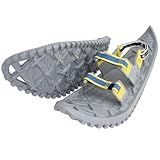
The Drifter is the outlier in this set, and that's the point. At 30 in long and 9 in wide, its deck is eight inches longer than the two 22-inch picks, which is a serious float advantage when the snow isn't packed. It's also the only pair here with heel lifters, the small bars that prop your heel up on sustained climbs so your calves aren't stretched flat for a mile. Retrospec says the full-floating pivot moves naturally with your stride, and the double-ratchet bindings are described as fast to cinch on cold mornings.
That deck costs you. At 6.71 lb per pair, this is by a wide margin the heaviest pick here, nearly four times the Northern Lites figure. Nine inches of width also forces a wider gait than the 7 in and 7.6 in decks above.
It's the cheapest of the five and the one buyers choose most often in this group, and it's the only pick with both heel lifters and a carry bag. The trade-off is blunt: you're buying float and climbing hardware, and paying for them in leg weight on every stride.
Pros:
- Longest deck here at 30 in
- Only pick with built-in heel lifters
- Double-ratchet bindings for fast cinching
- Cheapest of the five
- Mesh carry bag included
Cons:
- Heaviest pair in the set at 6.71 lb
- 9 in width forces a wider stride
- Warranty listed only as "Limited", with no term stated
- Least race-oriented shape of the five
2. Northern Lites Ultralight Running Snowshoes for Speed & Performance — Best premium
At 1.75 lb per pair with a limited lifetime warranty, this is the race tool of the group and nothing else here is close on weight.

Best for: racers and fast runners under 200 lbs Skip it if: you break trail in deep, unpacked snow
Nothing in this set touches the weight figure. 1.75 lb per pair works out to 28 oz per shoe, and Northern Lites claims that's 30% lighter than other running snowshoes on average. The 7.6 in width is also the narrowest number here after the Eco Eva's 7 in, so your legs track close together instead of splaying. The brand describes T-6 racing aluminum crampons for grip when sprinting and cornering, plus polyurethane-coated decking that sheds snow and holds a low profile.
The limits are stated plainly on the listing, which I like. It's rated for athletes up to 200 lbs, the lowest ceiling of the picks that publish one. And at 20.2 in, it has the shortest deck in the set, which is the direct cost of that weight.
This is the most expensive pick here and the slowest seller of the five, with only one seller listing it. What you get for the outlay is the limited lifetime warranty, longer than anything else in the group, and a shape built for packed race courses rather than powder.
Pros:
- Lightest pair here at 1.75 lb
- Limited lifetime warranty, the longest in the set
- Speed lace binding for fast entry
- Narrow 7.6 in deck suits a close gait
- Race crampons claimed for cornering grip
Cons:
- Shortest deck at 20.2 in, so least float
- Rated only to 200 lbs
- Most expensive pick in this group
- Only one seller lists it
- No heel lifters
3. Crescent Moon Snowshoes Eco Eva — Most versatile
A 2 lb foam pair with a 3-year warranty and the narrowest deck here, sized across 6W to 13M.
Best for: packed trails and a natural running stride Skip it if: you need heel lifters for steep climbs
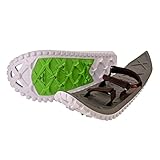
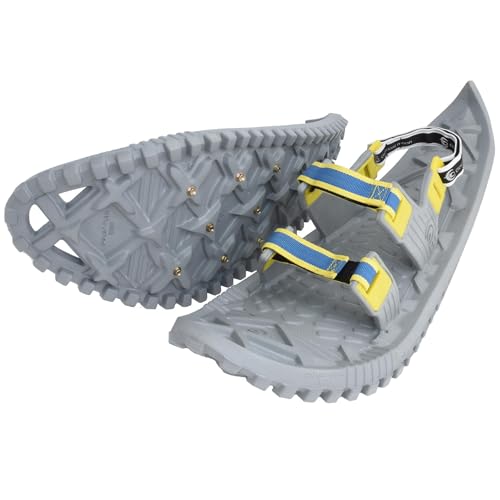
The Eco Eva sits closest to the sweet spot for most people. 2 lb per pair is only a quarter-pound heavier than the race pick, the 22 in deck is nearly two inches longer, and the 7 in width is the narrowest measurement in this comparison. Crescent Moon describes an EVA foam rocker platform that bends and rolls with the foot like an athletic shoe, with a teardrop shape meant to preserve your natural stride, plus ice spikes for hardpack. The published size range runs 6W to 13M.
The binding is hook-and-loop rather than a ratchet or lace system, which is quick and glove-friendly but gives you less mechanical clamping force than the Drifter's double ratchets. There's no heel lifter, so long climbs stay flat-footed. Foam decks also don't let you tension or swap parts the way a framed shoe does.
It's the second-cheapest of the five and carries a 3-year manufacturer warranty. Against the Drifter, you're trading eight inches of deck for 4.7 lb of relief.
Pros:
- Narrowest deck here at 7 in
- 2 lb pair weight, second-lightest in the set
- 3-year manufacturer warranty
- Published size range from 6W to 13M
- Second-cheapest pick
Cons:
- No heel lifters for sustained climbs
- Hook-and-loop binding clamps less firmly than ratchets
- 22 in deck limits float in deep snow
- No stated user weight ceiling
4. Yukon Charlie's Run Ultra-Lite Snowshoe 8-inch x 22-inch — Best upgrade
The highest published user weight limit here at 225 lbs, on a 7075-T6 aluminum race frame.

Best for: heavier runners wanting an aluminum race frame Skip it if: you want the longest warranty here
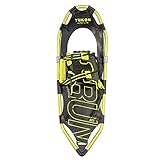
This is the pick for runners the Northern Lites shoe rules out. Yukon Charlie's states an 8x22-inch frame built for users up to 225 lbs, 25 lbs more headroom than the race pick publishes, on the same 7075-T6 aluminum alloy. The stated pair weight in the feature copy is 2.5 pounds. The brand describes Tech Weave nylon decking with a polyurethane coating that stays soft in cold temperatures and runs quieter on snow, a Swift Strap heel strap for on-the-fly adjustment, and a forged steel front crampon.
Note the specification confusion on the listing: the weight field reads 3.53 oz while the feature bullet says 2.5 pounds. Those cannot both describe a pair, so treat the number as unsettled and verify it on the live page before buying.
The 1-year warranty is the shortest here, against 3 years from both Crescent Moon picks and lifetime coverage on the Northern Lites. It's mid-range for price in this group and the model dates to 2018. You're paying for a framed race shape with real weight headroom, and accepting the thinnest coverage in the set.
Pros:
- Highest published weight limit at 225 lbs
- 7075-T6 aluminum frame
- Forged steel front crampon
- Swift Strap heel adjustment
- Coated nylon decking claimed quieter in cold
Cons:
- Shortest warranty in this set at 1 year
- Conflicting weight figures on the listing
- 8 in width is second-widest here
- Oldest design in the group, released 2018
- Only one seller lists it
5. Crescent Moon EVA Unisex Ultralight EVA Foam Snowshoes — Best minimal setup
A 24-inch foam deck with hook-and-loop straps and included ice cleats, and nothing to fiddle with in the cold.

Best for: cold-morning simplicity with gloves on Skip it if: weight on the foot matters most to you
This is the simplest pair here. There are no ratchets, no laces and no lifters, just hook-and-loop bindings that Crescent Moon calls the most intuitive to use and says stay tight across rolling terrain. Traction comes from rubber lugs on the dual-density rocker deck, with ice cleats included for hardpack. At 24 in, the deck is the second-longest in this set, four inches ahead of the race pick and two ahead of the two 22-inch options.
The weight is where it gives ground. The specification lists 3.5 lb, while the feature copy claims 3 lb per pair. Either figure puts it well above the 2 lb Eco Eva from the same brand, which uses the same rocker concept on a shorter, narrower deck.
It's the second most expensive pick here despite that weight, which is hard to justify against its own stablemate unless you specifically want the extra deck length. The 3-year manufacturer warranty is solid, and the 8 in width matches the Yukon Charlie's. Buy it for the deck and the zero-fuss straps, not the numbers on the scale.
Pros:
- Second-longest deck here at 24 in
- Hook-and-loop bindings work with gloves on
- Rubber lugs plus included ice cleats
- 3-year manufacturer warranty
- Rocker deck flexes with the foot
Cons:
- 3.5 lb listed weight, heavy for its deck size
- Second-highest price in this group
- Listing weight and feature weight disagree
- No heel lifters and no stated weight limit
- Heavier than the cheaper Eco Eva from the same brand
Foam deck or aluminum frame: which suits your trail?
The set splits cleanly. Two foam decks from Crescent Moon, three aluminum frames from Retrospec, Northern Lites and Yukon Charlie's. The choice isn't about quality. It's about what your snow does.
Foam decks are one moulded piece. The Eco Eva and EVA models both use hook-and-loop straps and a rocker profile, so there's less to break and less to adjust with numb fingers. Crescent Moon states the Eco Eva is 100% biodegradable and dissolves into soil after burial. Both carry 3-year warranties.
Aluminum frames give you hardware. The Drifter's double ratchets and heel lifters, the Northern Lites speed laces and race crampons, the Yukon Charlie's Swift Strap and forged steel front crampon. That hardware is what makes steep and icy terrain manageable, and it's what lets the Northern Lites pair hit 1.75 lb without losing structure.
My rule: foam for rolling, packed, mostly flat trail where simplicity wins. Aluminum for climbs, ice and variable depth where you need bite and adjustment. If your usual loop has more than a couple of hundred feet of gain, the heel lifters alone tilt it toward the Drifter.
What the listings leave out
Three gaps are worth knowing before you commit, because no amount of reading the page will close them.
- Weight limits are inconsistent. Only two picks publish one: 200 lbs for the Northern Lites, 225 lbs for the Yukon Charlie's. The Retrospec and both Crescent Moon models state none. Your body weight plus a pack is what determines float, so an unstated limit is a real unknown.
- Pair weight versus single weight. Several listings mix these. Northern Lites states 28 oz per shoe and 1.75 lb per pair, which don't reconcile. Yukon Charlie's lists 3.53 oz in one field and 2.5 pounds in another. Crescent Moon's EVA says 3.5 lb in the specification and 3 lb in the copy.
- Boot compatibility isn't specified. Only the Eco Eva publishes a size range, 6W to 13M. Northern Lites mentions running shoes or lightweight boots. The rest say nothing about what footwear the bindings accept.
Check all three on the live page before you order. Measure your winter shoe if the binding range isn't stated.
The verdict
The Retrospec Drifter is the default choice among the best running snowshoes here, because a 30-inch deck and heel lifters cover more real conditions than any other pick in this set, and it's the cheapest of the five while doing it. It floats when the snow is soft and it climbs when the trail tilts, which is more than the four lighter picks can say.
Two conditions flip that. First, if you race or run consistently on packed trail and weigh under 200 lbs, the Northern Lites pair wins on the one figure that matters there. 1.75 lb per pair against 6.71 lb is not a marginal difference, it's a category difference, and the limited lifetime warranty is the longest coverage in this comparison. Second, if you want light weight without the price position or the 200 lb ceiling, the Crescent Moon Eco Eva does 2 lb on the narrowest deck here at 7 in, with a 3-year warranty and a published 6W to 13M size range.
The runner-up's exact advantage is weight, nothing else. Northern Lites gives up ten inches of deck and 25 lbs of headroom to get there. Deep snow will find that out. Packed trail never will.
FAQ
Are the best running snowshoes worth it over regular hiking snowshoes?
The best running snowshoes are worth it if your terrain is packed and you're covering distance, because narrow decks like the 7 in Eco Eva or the 7.6 in Northern Lites let your legs track close together instead of splaying. On soft, unbroken snow, a longer hiking-style deck like the Drifter's 30 in serves you better regardless of how you move.
What deck length should I look for in running snowshoes?
Deck length should be matched to snow condition and body weight together. On groomed or well-packed trail, 20 in to 22 in is enough and the lighter pair wins. In unpacked powder, 24 in to 30 in stops you punching through. This set spans 20.2 in to 30 in, so the range covers both cases.
Which is better, the Retrospec Drifter or the Northern Lites race pair?
Between the Retrospec Drifter and the Northern Lites pair, choose by snow. The Drifter's 30 in deck and heel lifters win in deep or steep terrain and it costs less. The Northern Lites pair wins on packed courses at 1.75 lb against 6.71 lb, with a limited lifetime warranty, but it's rated only to 200 lbs.
Do any of these snowshoes have a stated weight limit?
Stated weight limits appear on only two of these five. Northern Lites publishes a 200 lb ceiling for athletes, and Yukon Charlie's states its 8x22-inch frame is built for users up to 225 lbs. The Retrospec Drifter and both Crescent Moon foam models publish no limit, so confirm that on the live listing.
What's the most common mistake buying snowshoes for running?
The most common mistake buying snowshoes for running is treating pair weight as the only number that counts. A 1.75 lb pair that sinks in powder costs you more energy per mile than a 6.71 lb pair that stays on the surface. Sort your snow conditions first, then optimise weight within the decks that actually float you.
Start with your usual winter loop, not the specification sheet. Walk through it in your head: how deep the snow gets after a fresh fall, how much you climb, whether the surface is packed by other runners or untouched. If any part of that answer is "deep" or "steep", the Retrospec Drifter's 30 in deck and heel lifters are the safer default, and it happens to be the cheapest here. If the whole loop is packed and flat and you weigh under 200 lbs, buy the 1.75 lb Northern Lites pair and enjoy the difference. Everything else in this set is a compromise between those two answers.