Best Beginner Snowshoes: Franklin Arctic Trails Wins

Six beginner snowshoes compared by deck size, binding style, weight capacity and warranty. Franklin's Arctic Trails leads on simplicity; MSR's Evo Trail kit wins on hardware.

By Mckinley BirdUpdated 18 min read
On this page
- Best beginner snowshoes at a glance
- Who this shortlist is for, and who should look elsewhere
- 1. Franklin Sports Arctic Trails — Best overall
- 2. Retrospec Drifter Snowshoes — Best for families
- 3. G2 GO2GETHER 25" Snowshoes — Most versatile
- 4. Yukon Charlie's SNO-Bash Youth — Best budget pick
- 5. Yukon Charlie's Sherpa Kit — Best warranty
- 6. MSR Evo Trail Snowshoe Kit — Best premium
- How I screened the field down to six
- Deck size vs. body weight: the one number that decides fit
- What the listings do not tell you about beginner snowshoes
- Bindings, crampons and heel lifts: which features matter first?
- How much snowshoe do you actually need to start?
- The verdict
- FAQ
The best beginner snowshoes are the Franklin Sports Arctic Trails, a 25-inch aluminum-framed pair at 3 lb per shoe with dual ratchet bindings and a carry bag, rated by the listing for users from 130 to 210 lb. Step up to the MSR Evo Trail Snowshoe Kit if you want steel traction, DynaLock trekking poles and a foam-seat pack in one box, at the top of this price set.
Best beginner snowshoes at a glance
| Pick | Deck size | Weight capacity | Price |
|---|---|---|---|
Best overall Franklin Arctic Trails |
25 x 8.3 in | 130–210 lb (listing) | Check Price |
Best for families Retrospec Drifter |
30 x 9 in | not listed | Check Price |
Most versatile G2 GO2GETHER 25" |
25 x 8 in | up to 200 lb (listing) | Check Price |
Best budget pick Yukon Charlie's SNO-Bash Youth |
7 x 16 in | 25–100 lb (listing) | Check Price |
Best warranty Yukon Charlie's Sherpa Kit |
9 x 30 in | 201–250 lb (listing) | Check Price |
Best premium MSR Evo Trail Kit |
22 in (31.5 x 11 in pack) | not listed | Check Price |




Every deck size is a shoe length, except the MSR, whose listed 22 in refers to the shoe and whose 31.5 x 11 in figure is the pack dimension. Weight capacity is copied straight from the product listing where the maker publishes one.
Who this shortlist is for, and who should look elsewhere
The six best beginner snowshoes here are aimed at people walking on rolling terrain, groomed winter trails, meadows and light forest tracks. Not steep alpine bowls, not overnight expeditions, not ice-axe territory. Four of the six use HDPE or aluminum decks in the 25 to 30 inch range, which is the standard recreational size for adults under about 250 lb.
If you weigh over 250 lb with a pack, none of these six is a confident answer. Deeper-flotation shoes exist and this set does not include one. If you plan to summit peaks or traverse hard-packed traverses in mountaineering boots, look at technical shoes with aggressive steel crampons front and back, not the lighter recreational geometry here.
A note on the search term. Amazon returned this set for beginner intent, and the products themselves span kids' 7 x 16 in decks up to a premium 22 in adult kit. That range is normal for the query but it does mean "beginner" is doing a lot of work. The right beginner snowshoe for a 60 lb child is not the right beginner snowshoe for a 220 lb adult. Match the deck size and stated capacity to the actual user before anything else.
1. Franklin Sports Arctic Trails — Best overall
A 25-inch aluminum shoe with rotating crampons, dual ratchet bindings and a carry bag, sized for adults 130 to 210 lb.
Best for: adults 130 to 210 lb wanting a simple 25-inch shoe with a carry bag Skip it if: you regularly climb steep grades or weigh more than 210 lb
The Arctic Trails wins the top spot because it does what a first pair of snowshoes should. The frame is 25 in by 8.3 in, the listed weight is 3 lb per shoe, and Franklin publishes a 130 to 210 lb capacity range on the listing. That figure covers most adult buyers of this category, and it is one of only two picks here to state a clear capacity band in adult terrain.
The dual ratchet bindings are the standard, no-surprises design: two straps, cinch, go. Franklin says the rotating crampons dig in for traction and that the aluminum frame keeps the pair light. The listing also includes a carry bag, which sounds trivial until you try to fit a wet pair into a car boot at the end of a walk.
Trade-offs against the rest of this set are real. There is no heel lifter on this shoe, which the Retrospec, G2 and Yukon Charlie's Sherpa all publish. The warranty is 90 days, the shortest in the group. And the sales figure sits near the middle of the set. This is a straightforward recreational shoe, not a technical one.
Pros:
- Clear 130–210 lb capacity range published
- Listed weight of 3 lb per shoe
- Dual ratchet bindings, no learning curve
- Rotating crampons claimed for traction
- Carry bag included in the box
Cons:
- 90-day warranty, shortest in this set
- No heel lifter for steep climbs
- Adult sizing only, no smaller frame option
2. Retrospec Drifter Snowshoes — Best for families
A 30-inch aluminum-frame shoe with heel lifters, a double-ratchet binding and a mesh carry bag, sold as a men's and women's unisex model.

Best for: mixed-ability groups sharing a longer 30-inch deck across users Skip it if: you want a shorter deck for tight, wooded trails
The Drifter goes on a 30 in by 9 in frame, longer than the Franklin or the G2, which puts it in the range families reach for when a heavier parent and a lighter partner share a pair. Retrospec does not publish a capacity number on this listing, which is a real gap for a beginner buyer, so treat the 30-inch length as the guide: longer decks float better in deeper snow and under heavier loads.
Retrospec calls out heel lifters on this model, which flip up under your heel to reduce calf strain on a sustained climb. Neither the Franklin nor the MSR listings mention lifters, so within this six-shoe set the Drifter is one of only three heel-lift options. The double-ratchet binding is the same architecture as the winner. The mesh carry bag is included.
The Drifter has the second-lowest sales rank of the six here, which puts it near the top of the group for buyer interest. The trade-off is the missing capacity figure and the longer footprint. On tight switchbacks or in dense brush, a 30-inch tail catches. On open snow, it floats.
Pros:
- 30 x 9 in frame for better flotation
- Heel lifters listed for steep climbs
- Double-ratchet binding, quick on and off
- Mesh carry bag included
- Second-fastest seller of the six here
Cons:
- No weight capacity published on the listing
- 30-inch length awkward in tight woods
- Warranty stated only as "Limited"
3. G2 GO2GETHER 25" Snowshoes — Most versatile
A 25-inch HDPE-deck shoe at 3.3 lb per shoe with EVA-padded bindings, a heel lift, a one-finger ratchet and a one-year manufacturer warranty.

Best for: beginners who want heel lifts and EVA padding without the premium price Skip it if: you need a warranty longer than one year
The G2 is the pick that stacks the most published features against the mid-price position. It is a 25 in by 8 in deck, listed at 3.3 lb per shoe, with a stated capacity up to 200 lb. G2 says the deck is HDPE for flotation, the crampons are aluminum, the binding is a one-pull ratchet designed to work with cold hands, and there is EVA foam padding inside the binding. It is also the only pick under the premium tier to publish a full one-year manufacturer warranty.
Head-to-head against the Franklin, the G2 adds a heel lift and swaps aluminum decking for HDPE. Against the Retrospec, the G2 loses 5 inches of deck length but gains a published capacity figure and a longer warranty. That is a genuine "most versatile" case: it does not lead on any single axis, but it publishes more of the numbers a beginner would want to compare.
The one clear weakness is that the crampon geometry is not detailed in the listing beyond "sharp." For deep powder or heavier users, the Retrospec's longer deck or the MSR's steel traction is the safer answer.
Pros:
- 1-year manufacturer warranty published
- Listed capacity up to 200 lb
- Heel lift and EVA-padded binding
- One-finger ratchet designed for cold hands
- HDPE deck for flotation
Cons:
- Crampon spec described only as "sharp"
- 25-inch deck limits deep-powder use
- Heavier than the Franklin at 3.3 lb per shoe
4. Yukon Charlie's SNO-Bash Youth — Best budget pick
A 7 x 16 in youth aluminum snowshoe built for 25 to 100 lb users, with a Ripcord Easy-Pull binding, at the lowest price position in this set.
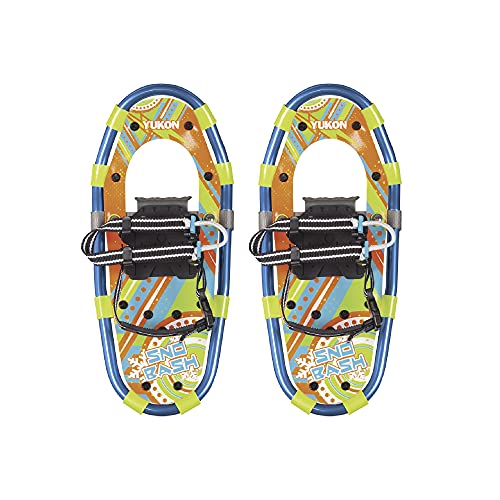
Best for: kids and lighter users from 25 to 100 lb on packed trails Skip it if: an adult over 100 lb needs to wear them
The SNO-Bash is the cheapest of the six here and the only pick sized for children. The frame is 7 in by 16 in, and Yukon Charlie's states a 25 to 100 lb weight range. The listing also gives 2.2 lb as the shoe weight in the feature bullets, though the spec block shows 3.53 oz, which is a listing inconsistency worth flagging: treat the 2.2 lb figure as the maker's stated shoe weight and check the box on arrival.
Yukon Charlie's calls the binding a Ripcord Easy-Pull, designed so a child can strap in with one motion, and describes an Energy Flex axle that pivots with a natural stride. Both are the right choices for a first pair on a young walker. The 6000-series aluminum frame is the recreational standard.
The trade-off is obvious: this is a youth shoe. Do not buy it for a full-size adult, no matter how promising the price looks. And the warranty runs one year, the same as the G2 and the adult Sherpa Kit further down the list.
Pros:
- Cheapest of the six here
- Sized specifically for 25–100 lb users
- Ripcord Easy-Pull binding for kids
- 1-year warranty published
- Aluminum rocker frame
Cons:
- Youth sizing only, not for adults
- Weight figure inconsistent between listing fields
- Small deck offers limited float in deep snow
5. Yukon Charlie's Sherpa Kit — Best warranty
A 9 x 30 in HDPE-deck kit rated for 201 to 250 lb users, bundled with trekking poles and a travel bag, at the second-highest price position here.

Best for: heavier users up to 250 lb who want poles and a bag in one buy Skip it if: you already own trekking poles and a pack
The Sherpa Kit earns its slot on two numbers. First, the listed capacity of 201 to 250 lb is the highest published figure in this set and the only one aimed squarely at heavier adults. Second, the kit bundles a shoe, a pair of trekking poles and a travel bag in one purchase, which is a real convenience for a first-time buyer who does not yet own poles.
The shoe itself is a 9 in by 30 in HDPE deck, which Yukon Charlie's says stiffens for power through deep snow. The binding is called Quick Click II with a Rapid-Lite Flex heel strap, and the listing describes it as a beginner-friendly ratchet. Yukon Charlie's uses the phrase "built with beginners in mind" in its own copy, which is the closest any listing in this set comes to naming the search intent directly.
Against the MSR Evo Trail Kit, the Sherpa costs less and carries the higher capacity figure, but the MSR publishes a longer warranty and steel traction rather than plastic. Against the Retrospec, the Sherpa adds poles and a bag but loses on how fast it sells here.
Pros:
- Listed capacity 201–250 lb, the highest here
- Trekking poles and travel bag included
- HDPE deck for stiffness in deep snow
- Quick Click II ratcheting binding
- 1-year warranty published
Cons:
- Slowest seller of the six in this set
- Only one year of warranty despite premium pricing
- 30-inch length awkward on tight trails
6. MSR Evo Trail Snowshoe Kit — Best premium
A 22-inch snowshoe kit with steel traction, DynaLock aluminum trekking poles, a PFAS-free coated nylon carry pack and a 3-year limited warranty.

Best for: beginners buying once and keeping the kit for a decade Skip it if: you are not sure you will snowshoe more than a few weekends a year
The MSR Evo Trail Kit is the most expensive pick here and the one that raises the hardware baseline. MSR says the shoe uses steel traction rather than aluminum or moulded plastic teeth, which is the meaningful upgrade for ice and hard-pack. The Paraglide bindings, in MSR's words, offer near-universal footwear compatibility and all-day comfort. The kit ships with two-section DynaLock aluminum poles and a roll-top carry pack in PFAS-free coated nylon that doubles as a foam seat.
The listing's 22-inch size figure describes the shoe. The 31.5 x 11 in dimensions refer to the packed kit. The 5.92 lb weight is the total kit weight, not per shoe. Compared to any other pick here, the MSR's 3-year limited warranty is the longest published, which is a real signal for a beginner intending to keep a first pair for many seasons.
The honest downsides: this is the slowest-selling of the six on Amazon, and MSR does not publish a rider weight capacity in this listing. The 22-inch deck is also shorter than the Retrospec or Sherpa, so heavier users pushing deep powder should reconsider deck length before deck material.
Pros:
- 3-year limited warranty, the longest here
- Steel traction rather than aluminum crampons
- DynaLock aluminum poles included
- Roll-top pack doubles as a foam seat
- Paraglide binding for wide footwear range
Cons:
- Most expensive pick in this set
- No rider weight capacity published
- Slowest seller of the six here
How I screened the field down to six
The starting point was the criteria a beginner actually cares about: deck size, published weight capacity, binding style, warranty, and whether the package includes what a first-timer will otherwise have to buy separately. Nothing else counted at the shortlist stage.
Three cuts trimmed the field to the six above.
- Cut for missing sizing information. Any listing that did not state a shoe length, or at least a deck footprint, was dropped. A beginner cannot pick a snowshoe by colour.
- Cut for adult-only bindings on youth-frame decks and vice versa. A shoe advertised as universal but sized 7 x 16 in is a kids' shoe. Mixing the two categories in one pick creates the wrong purchase for someone.
- Cut for feature-only marketing without matching specifications. A bullet claiming "professional traction" is not a specification. If the listing did not back a claim with a number or a named material, that claim carried no weight in ranking.
What survived split cleanly by price position. Two entry picks, two mid picks, two premium picks. That distribution is not a coincidence: it reflects what Amazon actually returns for the query, and it lets the ranking match a buyer's budget rather than force a single answer on every reader.
Deck size vs. body weight: the one number that decides fit
Most beginner snowshoes guides compare crampon aggression. That is not what decides your first pair. Deck size relative to your body weight, in boots and with a pack, is the real deciding number.
Here is the trick. A snowshoe is a flotation device. Longer and wider decks displace more snow and keep you from post-holing to your knees. Shorter decks are lighter and easier to manoeuvre in tight terrain but sink in deeper powder. The recommended weight capacity a maker prints on the listing is a rough guide to the deck's flotation range in average snow.
Only three picks in this set publish a clear capacity range: the Franklin at 130 to 210 lb, the G2 at up to 200 lb, and the Sherpa Kit at 201 to 250 lb. The SNO-Bash publishes 25 to 100 lb as a youth shoe. The Retrospec and MSR do not.
For a beginner, use this as your cutoff:
- Under 130 lb on packed trails: a 21 to 25 in deck is usually enough.
- 130 to 200 lb on mixed snow: 25 in is the recreational standard.
- 200 to 250 lb, or lighter users in deep powder: step up to 30 in.
- Above 250 lb: none of the six picks here is the confident answer.
Deck size in inches is more useful than any marketing description. A 25-inch shoe is a 25-inch shoe, whether the deck is aluminum or HDPE.
What the listings do not tell you about beginner snowshoes
Product listings are optimised for buying, not for using. A few gaps show up across this set that a first-time buyer should know before checkout.
- Boot compatibility is fuzzy. Every listing here says the bindings fit "any boot" or "a variety of boots." In practice, a stiff insulated winter boot straps in cleanly. A soft trail runner or a bulky pac boot may not. Measure the sole of the boot you plan to wear, front to back, before you buy.
- Weight figures are inconsistent. The Yukon Charlie's SNO-Bash lists 3.53 oz in one spec field and 2.2 lb in a feature bullet. Both cannot be correct. Read the whole listing, not just the top-line number.
- "Trekking poles included" is a big convenience but a small quality signal. The Sherpa Kit and the MSR Evo Trail Kit both bundle poles. The MSR names them as DynaLock aluminum with a two-section design. Yukon Charlie's does not name the pole model. That difference matters if a pole snaps in the third season.
- Warranty length varies from 90 days to 3 years across this set. The MSR Evo Trail Kit is the only pick publishing 3 years. The Franklin is the only one at 90 days.
None of these gaps rules a shoe out. But they change how you read a listing.
Bindings, crampons and heel lifts: which features matter first?
Three moving parts on a snowshoe deserve real attention on the first buy.
- Binding style. All six picks here use a ratchet or Easy-Pull binding, which is the right choice for beginners. Ratchets are simple, they cinch straight, and they release with a lever. The G2 says its ratchet works with one finger in the cold. That is the feature to prioritise: whatever binding you can operate wearing gloves at -5C, on the tailgate of a car, is the right binding for you.
- Crampons. Only the MSR Evo Trail listing calls out steel traction specifically. The Franklin, G2 and Retrospec listings describe aluminum crampons. Aluminum is fine for packed snow and light ice. Steel bites harder on ice-crust and refrozen tracks. If you regularly walk on rain-crusted mornings after a thaw, steel earns its extra cost.
- Heel lift. A small flip-up bar under the heel reduces calf strain on sustained climbs. The Retrospec, G2 and Sherpa Kit publish heel lifters. The Franklin, SNO-Bash and MSR do not name one in the listing. If your local trails include any climb longer than a few minutes, prioritise a shoe with a heel lift.
In order of importance for a first pair: binding you can use with gloves, deck size for your weight, crampons matched to your snow, heel lifts if you climb.
How much snowshoe do you actually need to start?
Price positions in this set span from an entry-tier youth shoe to a premium adult kit with poles and a pack. Here is what each tier actually buys.
- Entry tier. The Franklin Arctic Trails and the SNO-Bash sit here. You get an aluminum-framed shoe, a ratchet binding, a stated capacity or age range, and a carry bag. What you do not get: heel lifts, extended warranty, or bundled poles.
- Mid tier. The Retrospec Drifter and the G2 GO2GETHER 25" pick up heel lifters, EVA padding on the G2, and a longer 1-year warranty in the G2's case. This is the tier where a shoe starts feeling less like a one-season purchase.
- Premium tier. The Sherpa Kit and the MSR Evo Trail Kit add trekking poles and a pack. The MSR pushes further with a 3-year warranty and steel traction. This is a keep-it-a-decade purchase, not a try-it-once one.
Most beginners are best served by the mid tier if budget allows. The entry tier makes sense for kids and casual walkers. The premium tier makes sense once you know you will be on snow more than a handful of weekends.
The verdict
The Franklin Sports Arctic Trails is the winner because it publishes the numbers a beginner needs to make a confident decision. A 25 in by 8.3 in deck, 3 lb per shoe, dual ratchet bindings and a stated 130 to 210 lb weight capacity together describe a shoe most adult first-timers can buy without second-guessing themselves. The included carry bag is a small thing that removes a friction point on day one.
Two conditions flip the recommendation. First, if the walker weighs more than 210 lb, the Yukon Charlie's Sherpa Kit is the better buy: its published 201 to 250 lb range is the highest here, and the bundled poles and travel bag mean one purchase instead of three. Second, if you know you will snowshoe frequently over many seasons, the MSR Evo Trail Kit's 3-year limited warranty, steel traction and DynaLock poles justify the higher price position in this set.
For a child from 25 to 100 lb, the SNO-Bash is the correct answer regardless of what the adult in the family is wearing. Do not mix categories: a youth shoe on an adult is a bent frame.
FAQ
Are the best beginner snowshoes worth buying if I only walk a few weekends a year?
The best beginner snowshoes are worth buying for a few weekends a year if the alternative is skipping winter walks entirely. Focus on the entry tier: the Franklin Arctic Trails covers a wide adult weight range and includes a carry bag. Rentals add up quickly across even a short season, and a basic pair keeps its value if you decide to walk more.
Is a 25-inch snowshoe big enough for a beginner adult?
A 25-inch snowshoe is big enough for most beginner adults between 130 and 200 lb on packed or moderately deep trails. The Franklin at 25 in and the G2 at 25 in both publish capacity figures inside that range. Heavier users, or lighter users walking in fresh unbroken powder, should step up to a 30-inch deck like the Retrospec Drifter or the Sherpa Kit.
What is the difference between the Franklin Arctic Trails and the Retrospec Drifter?
The difference between the Franklin Arctic Trails and the Retrospec Drifter comes down to deck length and features. Franklin runs a 25 x 8.3 in aluminum deck with a published 130 to 210 lb range and no heel lifters. Retrospec runs a longer 30 x 9 in aluminum deck with heel lifters listed but no published weight capacity. Choose Franklin for tight trails; choose Retrospec for deeper snow.
Do I need trekking poles for my first snowshoe walk?
You need trekking poles for your first snowshoe walk on any terrain with grade changes, and they help balance even on flat ground. The Sherpa Kit and the MSR Evo Trail Kit include poles in the box, which is a real convenience for first-time buyers. If you buy a pole-less pair like the Franklin or the G2, plan on adding a pair separately before heading out.
What is the biggest mistake beginners make buying snowshoes?
The biggest mistake beginners make buying snowshoes is choosing by price and colour rather than by deck size and stated weight capacity. A shoe too small for the user post-holes into the snow. A shoe too large for the user snags in brush and feels clumsy. Match the published capacity range to your body weight in boots with a pack before comparing anything else on the listing.
Snowshoeing rewards a boring, correct first purchase far more than a clever one. Pick the shoe whose deck size and published weight capacity match the person wearing it, then read the binding description twice and picture yourself using it with cold hands. For most adult beginners in this set, that reasoning ends at the Franklin Arctic Trails. For heavier users, it ends at the Sherpa Kit. For families with kids under 100 lb, add the SNO-Bash and do not try to make one pair fit everyone. Get outside on the first quiet snowfall of the season and the pair you chose fades into the background, which is exactly what a good first pair should do.