Best Fuzzy Logic Rice Cooker for Seniors: Cosori Wins

Simple controls, readable displays and dishwasher-safe parts matter more than menu count. Here's how six fuzzy logic rice cookers compare for older cooks.

By Mckinley BirdUpdated 17 min read
On this page
- Best fuzzy logic rice cooker for seniors at a glance
- How I cut the field from forty listings to six
- What actually decides this for an older cook
- 1. Cosori Rice Cooker 10 Cup — Best overall
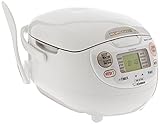
- 2. Zojirushi NS-ZCC10 Neuro Fuzzy — Best premium
- 3. Toshiba OriginTaste 10-Cup — Best for heavy use
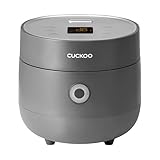
- 4. CUCKOO Micom CR-0375FG — Best for families
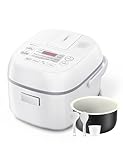
- 5. Toshiba Mini TRCS02 — Best compact
- 6. Martha Stewart 8 Cup Cooked — Best budget pick
- How heavy is too heavy to lift the inner pot?
- What the listings quietly leave out
- Cosori versus Zojirushi: which one at the end of a long day?
- The verdict
- FAQ
The best fuzzy logic rice cooker for seniors is the Cosori 10 Cup, because it pairs an 18-function menu with a dishwasher-safe ceramic inner pot and a 2 year warranty, which no other pick here matches. The Zojirushi NS-ZCC10 is the alternate choice if a lighter 3.09 lb body and a smaller 5.5-cup capacity suit a one or two-person household better.
Getting this wrong costs more than a bad dinner. A cooker with a fiddly membrane panel, tiny grey-on-grey icons or a heavy cast pot ends up shoved to the back of the counter within a month. That is the failure mode driving every decision below: not which machine cooks the most types of rice, but which one an older cook will still be using in year three.
Best fuzzy logic rice cooker for seniors at a glance
| Pick | Capacity | Inner pot | Price |
|---|---|---|---|
Best overall Cosori Rice Cooker 10 Cup |
10 cups uncooked | Ceramic, dishwasher-safe | Check Price |
Best premium Zojirushi NS-ZCC10 Neuro Fuzzy |
5.5 cups uncooked | Spherical nonstick | Check Price |
Best for heavy use Toshiba OriginTaste 10-Cup |
10 cups uncooked | 3.1mm ceramic nonstick | Check Price |
Best for families CUCKOO Micom CR-0375FG |
3 cups uncooked / 6 cooked | Nonstick, removable lid | Check Price |
Best compact Toshiba Mini TRCS02 |
3 cups uncooked | Nonstick, hand-wash | Check Price |
Best budget pick Martha Stewart 8 Cup Cooked |
4 cups uncooked / 8 cooked | Nonstick bowl | Check Price |



How I cut the field from forty listings to six
Three cuts did most of the work. The first removed anything without stated fuzzy logic in the listing copy: a switch-and-thermostat cooker is a different product, no matter what the search page suggests. That knocked out most one-touch models under a certain price position.
The second cut removed cookers whose control layouts were unreadable in the listing photos: dark charcoal panels with dark icons, no backlight, or buttons the size of a pea. Older eyes and older fingertips both suffer here, and a fuzzy logic rice cooker for seniors that requires reading a manual before every use is not the right buy.
The third cut removed cookers with hand-wash-only inner pots that also had no removable inner lid. Cleaning steam vents and lids by hand is the daily friction of owning one of these, and if a listing describes neither a dishwasher-safe pot nor a removable lid assembly, the machine gets harder to live with over years.
What survived: six fuzzy logic rice cookers spread across three capacity classes and three price positions. Two are 10-cup family sizes, two are around 3 cups for one or two people, and two land in the middle. Every survivor has a delay timer, every survivor has a keep-warm cycle, and every survivor has at least one dedicated brown rice mode.
What actually decides this for an older cook
Most guides to the best fuzzy logic rice cooker for seniors compare the menu count. That is the wrong axis. A machine with 18 modes and one with 8 both cook white rice the same way, because fuzzy logic itself is what does the work.
Three things decide it in practice, in this order.
- Pot weight and lift height. The inner pot comes out full of sticky rice, gets rinsed, and goes back in every day. A ceramic pot in a machine over 9 lb is a two-hand job for anyone with wrist trouble.
- How readable the panel is at arm's length. LED and LCD displays vary wildly. A back-lit screen with high-contrast text beats a printed grey overlay every time, and there is no way to fix the wrong choice after purchase.
- What has to be cleaned by hand. Steam vents clog. Inner lids trap starch. A cooker with a removable, rinseable lid and a dishwasher-safe pot is dramatically easier to live with than one that requires poking a chopstick into vent slots.
Menu count comes fourth, and only because a dedicated porridge or oat mode matters more to older cooks than a cake function anyone will use twice.
1. Cosori Rice Cooker 10 Cup — Best overall
The Cosori wins because it is the only pick in this set with a dishwasher-safe ceramic inner pot, an 18-function menu and a 2 year warranty on the same machine.
Best for: an older cook who batch-cooks rice, oats and steamed vegetables in one machine for the week Skip it if: you cook for one and never need more than two or three cups at a time
At 9.26 lb overall, this is not the lightest cooker in the set, but the dishwasher-safe ceramic pot changes the daily maths: rinse, load, forget. Cosori says the fuzzy logic runs a 7-step cooking process across white and brown rice with texture options, plus 3 grain modes and 3 oat modes. The listing also claims a 1000W Quick Rice cycle for shorter waits, an automatic 24-hour keep warm and a 24-hour delay timer.
Model is CRC-R501-KUS, released in 2024, dimensions 12.3 by 10.6 by 9.2 in. That is a footprint that fits under most standard cabinets with the lid closed. The 2 year warranty is the longest here, and it is the only pick where the manufacturer publishes a warranty over twelve months. Sits mid-range for price and sells faster than the rest of this set, which is a fair sign the combination is landing with buyers.
The trade-off against the Zojirushi is size and weight: this is a heavier, taller machine, built for a household that eats rice several times a week.
Pros:
- Dishwasher-safe ceramic inner pot and removable lid
- 2 year warranty, longest in this set
- 18 cooking functions covering rice, grains, oats and steam
- Quick Rice cycle at 1000W
- Fits under standard cabinets at 9.2 in tall
Cons:
- 9.26 lb body is the second-heaviest here
- Black panel with printed icons is less readable than a backlit LCD
- 10-cup capacity is more than a solo cook needs
2. Zojirushi NS-ZCC10 Neuro Fuzzy — Best premium
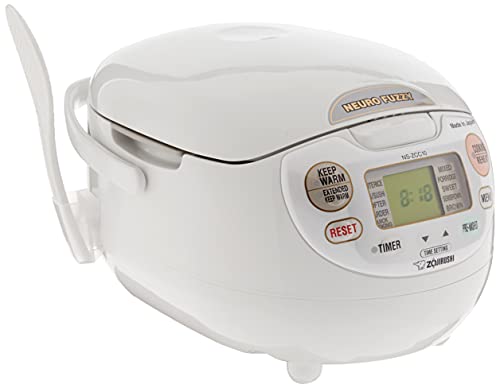
The Zojirushi is the lightest cooker here at 3.09 lb, and the only one advertising a spherical nonstick inner pan for even heat.
Best for: a one or two-person household that wants the easiest lift and the clearest panel Skip it if: you regularly cook for four or more, or you want a warranty over one year
Zojirushi calls this a 5-1/2 cup computerised rice cooker with Neuro Fuzzy logic technology, which is their branded fuzzy logic. Menu settings, in the listing's words, include white regular, sushi, softer, harder, mixed, porridge, sweet, semi-brown, brown, rinse-free and quick. That is a lot of rice-specific tuning in one machine, which is the point of the premium price position here.
Dimensions run 10.1 by 13 by 8.13 in. Model NS-ZCC10, released in 2005, still in production, 1 year limited warranty. It is wall mountable, which is unusual and useful in a small kitchen. The 3.09 lb weight is by far the lowest in this set, and it comes from a smaller pot rather than a flimsier build.
Two real costs sit against those wins. The 5.5-cup capacity means the family Sunday roast is not on. And the 1 year warranty is half what Cosori offers, on a machine that sits at the most expensive price position here.
Pros:
- 3.09 lb, the lightest cooker in this set
- Spherical nonstick inner pan for even heat
- Extensive rice-specific menu including sushi, softer, harder and rinse-free
- LCD clock and timer, retractable cord
- Wall mountable for tight kitchens
Cons:
- 5.5-cup capacity is small for family cooking
- 1 year limited warranty on the most expensive pick here
- The slowest seller of this set in the data
3. Toshiba OriginTaste 10-Cup — Best for heavy use
The Toshiba OriginTaste is the heaviest cooker here at 9.7 lb, and the only one whose listing specifies a 3.1mm ceramic-coated inner pot.

Best for: an older cook batch-preparing rice for a multi-generational household Skip it if: lifting a 9.7 lb machine or a heavy full pot is an issue
Toshiba lists 15 smart cooking functions including white rice, brown rice, mixed grain, jasmine rice, porridge, cake and egg modes. The 3D heating technology is a manufacturer claim rather than a measured figure, and Toshiba pairs it with a 24-hour timer and automatic keep-warm. The 10-cup uncooked pot yields up to 20 cups cooked, according to the listing, which is genuinely enough for a large family or a week of leftovers.
Accessories in the box, per the listing: measuring cup, rice spatula, soup ladle and steaming basket. That is more included kit than any other pick here. Removable steam vent cap and valve mean the fiddly cleaning bits come apart, and the inner pot is hand-washable rather than dishwasher-safe.
The two knocks are weight and price. At 9.7 lb this is the heaviest machine in the set, and it lands at the second-most-expensive position. No warranty length is published, which is a real gap for a premium purchase.
Pros:
- Largest yield here at up to 20 cups cooked
- 3.1mm ceramic-coated inner pot, thickest specified in this set
- Includes soup ladle and steaming basket alongside the usual cup and spatula
- Large LCD display for easy reading
- Removable steam vent for thorough cleaning
Cons:
- Heaviest cooker in this set at 9.7 lb
- Inner pot is hand-wash rather than dishwasher-safe
- No warranty length stated in the listing
4. CUCKOO Micom CR-0375FG — Best for families
The CUCKOO is the only pick here with a stated self-clean setting and a removable lid, aimed squarely at cutting daily maintenance.
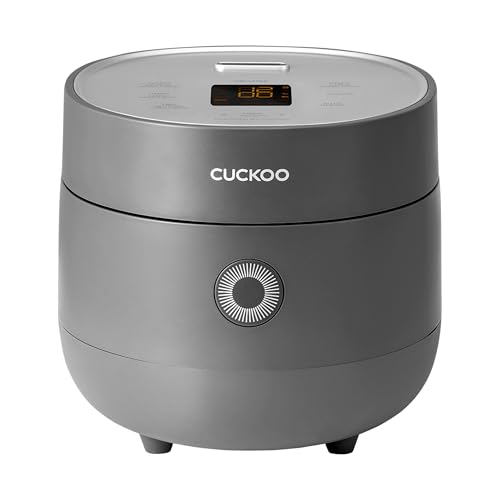
Best for: a two to four-person household that wants low-friction cleanup Skip it if: you need more than 6 cups cooked at once
CUCKOO calls this a 3-cup uncooked, 6-cup cooked machine, model CR-0375FG. The 8 lb body is lighter than either of the 10-cup cookers here, without dropping to the mini-cooker class. The listing lists a self-clean setting, a non-stick pot, a removable lid, a quick white rice mode, a timer and a warming mode. That combination is the case for it: the daily rinse-and-reset routine gets shorter.
CUCKOO says the fuzzy logic covers glutinous white rice, brown rice, oats and baby food, which is a genuinely useful spread for a household with mixed ages. The rice spatula and measuring cup come in the box.
What is missing from the listing is the interesting question. There is no stated warranty length, no published dimensions and no released date. For a machine that will live on a counter for years, that reads as thinner published support than the Cosori offers. The gray body with printed panel is also less readable than a backlit LCD, though the buttons themselves are spaced out.
Pros:
- Self-clean setting called out in the listing
- Removable lid for easier washing
- 8 lb body is lighter than 10-cup rivals
- Mid-range price position with fuzzy logic and delay timer
- Baby food and oat modes stated
Cons:
- No warranty length published
- No dimensions or release date in the listing
- 6-cup cooked ceiling is small for larger families
5. Toshiba Mini TRCS02 — Best compact
The Toshiba Mini is the second-lightest cooker here at 6.61 lb, sized for one to three people and priced near the bottom of the set.
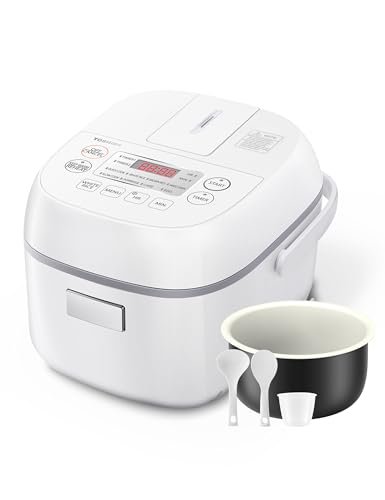
Best for: a solo cook or a couple with limited counter space Skip it if: you cook for guests often, or need a dishwasher-safe pot
Toshiba pitches this as a mini rice cooker for 1 to 3 people, 3 cups uncooked, model TRCS02. The 8 by 11 by 9 in footprint is the smallest here, and the 6.61 lb body is the second-lightest overall. Toshiba lists 8 cooking functions including white rice, quick cook, brown rice, mixed grain, slow cook and porridge, so the menu is narrower than the 10-cup machines but still covers everyday rice types.
The fuzzy logic, Toshiba says, senses the moisture content of the rice and adjusts temperature and cooking time accordingly. There is a large LED display and a 24-hour delay timer with auto keep warm. The listing is explicit that the inner pot is not recommended for the dishwasher and should be washed with mild soap and a soft cloth. That is a fair trade at this price position.
The trade-off against the CUCKOO is capacity and the missing self-clean cycle. Against the Zojirushi, this is a much less expensive machine with a shorter menu and no wall-mount option.
Pros:
- Compact 8 by 11 by 9 in footprint
- 6.61 lb, the second-lightest in this set
- Large LED display for readable programming
- Entry price position with fuzzy logic and delay timer
- 8 functions covering white, brown, mixed grain and porridge
Cons:
- Inner pot is not dishwasher-safe
- No warranty length stated
- 3-cup uncooked capacity is limiting for families
6. Martha Stewart 8 Cup Cooked — Best budget pick
The Martha Stewart is the cheapest of the six, and the only pick pairing a touch LED display with a 12-hour keep warm at the entry price position.

Best for: an older cook who wants fuzzy logic without paying mid-tier prices Skip it if: you need published dimensions, warranty or weight before you buy
Martha Stewart lists a 4-cup uncooked, 8-cup cooked machine, model CC010698-001, in sky blue. The listing describes 9 cooking modes: white rice, sushi rice, brown rice, quinoa, grains, steam, steel-cut oats, quick cook and keep warm. Martha Stewart says the fuzzy logic technology automatically adjusts temperature and cooking time. The intuitive LED touch display and the 30-minute to 24-hour delay timer are called out, and the keep-warm runs up to 12 hours.
The sky blue body is genuinely useful for older eyes: high-contrast colour against a white kitchen is easier to spot and easier to line up when placing the lid. The touch panel means fewer physical buttons to press, which cuts both ways: less to break, less tactile feedback.
The reason this is not higher is that the listing publishes less than any other pick here. No weight, no dimensions, no warranty, no release date. That is the cost of the entry price position, and it is the slowest seller in this set by a clear margin.
Pros:
- Cheapest of the six
- 8-cup cooked capacity, larger than the two 3-cup minis
- 9 cooking modes including sushi, quinoa and steel-cut oats
- 12-hour keep-warm on the entry price position
- Sky blue body is easier to see than dark finishes
Cons:
- No weight, dimensions or warranty published
- Touch panel offers less tactile feedback than physical buttons
- The slowest seller in this set
How heavy is too heavy to lift the inner pot?
Rice cooker weight matters twice: once when you move the whole machine, and once every day when you lift the full inner pot to serve or rinse it. The second one is the one that decides whether an older cook keeps using the thing.
Rough rule from the specs in this set: any cooker over 9 lb empty is going to have a pot that clears 4 lb when it is holding cooked rice and steam-water. That is heavy enough that grip weakness or shoulder trouble becomes a problem. The Cosori at 9.26 lb and the Toshiba OriginTaste at 9.7 lb both fall into that class, and both are the family-size options for a reason: they earn their weight by feeding four.
Below that, the CUCKOO at 8 lb, the Toshiba Mini at 6.61 lb and the Zojirushi at 3.09 lb all get progressively easier to live with. The Zojirushi is the outlier, and the difference is genuinely noticeable in a small kitchen where the machine gets shifted around a counter.
Two practical fixes when a heavier cooker is otherwise the right buy:
- Leave it on the counter permanently. Weight only matters when you move it. A cooker that lives in one spot only requires you to lift the pot, not the machine.
- Rinse the pot at the counter, not the sink. A silicone mat and a pitcher of water saves the walk to the sink with a heavy load.
What the listings quietly leave out
Every listing in this set publishes a menu count. Only three publish a weight. Only three publish dimensions. Only two publish a warranty. That gap is the story of buying kitchen appliances online in 2024, and it matters more for the best fuzzy logic rice cooker for seniors than for most other categories, because the missing figures are exactly the ones a careful buyer wants to check.
What the listings do not tell you, and what to do about it:
- Panel readability at arm's length. No spec covers this. Look at the product photos and ask whether you could read the mode names from three feet away.
- Button size and travel. Touch panels look tidy but give no feedback. Physical buttons with clear travel are easier for arthritic fingers.
- Steam vent cleaning. Only two listings mention removable steam vents. If the listing does not say the vent comes apart, assume it does not.
- Cord length and retraction. Only the Zojirushi mentions a retractable cord in this set. Cord management on a counter matters more than the marketing suggests.
None of these are dealbreakers by themselves. Together, they explain why two cookers with the same menu count can feel completely different in year two.
Cosori versus Zojirushi: which one at the end of a long day?
These are the two picks worth thinking about hardest, because they answer opposite questions. The Cosori is the machine you buy when you want one appliance to cover rice, grains, oats and steamed vegetables for a household. The Zojirushi is the machine you buy when rice is the only thing you cook in it, and you want that one job done as well as any small-appliance company knows how to do it.
Weight decides it more often than menu depth. The Zojirushi at 3.09 lb versus the Cosori at 9.26 lb is a threefold difference, and it shows up every time the pot goes to the sink. Panel readability leans Zojirushi too: the white LCD with clear text is easier to read from across a counter than the Cosori's black panel with printed icons.
Warranty and price flip it the other way. The Cosori's 2 year warranty is double the Zojirushi's 1 year, and it sits at the mid price position rather than the top. For a household eating rice four nights a week, the Cosori's ceramic pot going in the dishwasher is a bigger daily win than the Zojirushi's spherical pan.
The verdict
If you are buying one fuzzy logic rice cooker for a household of two to four, the Cosori 10 Cup is the right default. The 18-function menu, the dishwasher-safe ceramic inner pot and the 2 year warranty add up to a machine that survives daily use and stays easy to clean. The 9.26 lb body is the real cost, and the black printed panel is less readable than a backlit LCD.
If the household is one or two people, if you have wrist or shoulder trouble, or if the machine has to move around a small counter, the Zojirushi NS-ZCC10 is the better buy. The 3.09 lb weight is transformative, the spherical nonstick pan is unique in this set, and the rice-specific menu covers sushi, softer, harder, semi-brown and rinse-free rice. You pay the top price position and get a 1 year warranty. That is the trade.
The cutoff is roughly the size of the household. Above three regular eaters, the Cosori's capacity and dishwasher-safe pot pay for themselves inside a month. At or below two, the Zojirushi's lift weight and readable panel matter more than any menu the Cosori adds.
FAQ
What is a fuzzy logic rice cooker, in plain terms?
A fuzzy logic rice cooker uses sensors to adjust cooking temperature and time as the rice cooks, rather than following a fixed timer. Toshiba says the technology senses moisture content, and Cosori describes a 7-step cooking process. In practice it means the machine compensates for slightly wrong water amounts, cooler kitchens and older rice, which matters most when whoever is cooking cannot always stand over the pot.
Is a fuzzy logic rice cooker worth it for one or two people?
A fuzzy logic rice cooker is worth it for one or two people if you eat rice, oats or porridge more than twice a week, because the delay timer and keep-warm cycle turn breakfast and dinner into a load-and-forget task. The Zojirushi at 5.5 cups uncooked and the Toshiba Mini at 3 cups uncooked are both sized for that household, and both weigh less than any 10-cup machine in this set.
How much does the inner pot weight actually matter?
Inner pot weight matters daily, because the pot leaves the machine every time you serve, rinse or refill it. A cooker over 9 lb empty will have a pot that clears 4 lb when full of cooked rice. The Cosori at 9.26 lb and the Toshiba OriginTaste at 9.7 lb are both in that class, while the Zojirushi at 3.09 lb is dramatically easier to handle for anyone with grip or shoulder issues.
Cosori 10 Cup or Toshiba OriginTaste, which one for a big family?
Cosori 10 Cup or Toshiba OriginTaste comes down to warranty and cleaning. The Cosori publishes a 2 year warranty and a dishwasher-safe ceramic inner pot, while the Toshiba OriginTaste publishes no warranty length and a hand-wash pot, though its 3.1mm ceramic coating is the thickest specified here. For pure yield, Toshiba's stated up to 20 cups cooked wins. For daily use over years, the Cosori's paperwork and dishwasher pot pull ahead.
What is the biggest mistake buyers make in this category?
The biggest mistake in this category is choosing by menu count. A machine with 18 modes and a machine with 8 modes cook plain white rice identically, because fuzzy logic itself does the work. Weight, panel readability and whether the inner pot and lid come apart for cleaning decide whether the cooker still lives on the counter three years later. Those are the specs to compare first, not the mode list.
Start with the Cosori if the household is more than two people and someone will use the delay timer for breakfast oats or evening rice more than twice a week. The dishwasher-safe ceramic pot changes the daily cleanup calculation, and the 2 year warranty is real coverage rather than the twelve months most of this set offers. If the machine has to be light enough to move, or the panel has to be readable from across the kitchen, the Zojirushi is the pick that respects both constraints without cutting corners on the rice itself. Either way, buy once, leave it on the counter, and let the timer do the work.