Best Full Size Food Processor for a Daily Cook
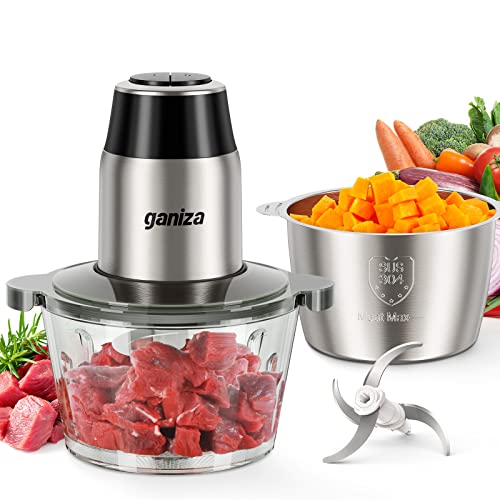
Five full-size food processors compared for the cook who actually uses one every day. Capacity, motor, weight and cleanup, ranked with the trade-offs named.

By Mckinley BirdUpdated 14 min read
On this page
- Best full size food processor for daily use at a glance
- How I narrowed five processors down
- What the obvious spec gets wrong
- 1. Ganiza Food Processors with 2 Bowls — Best overall
- 2. Hamilton Beach Food Processor 70730 — Runner-up
- 3. Ganiza Food Processor with Dual Bowls GC10-S — Best for pros
- 4. Ninja Professional Plus BN601 — Best minimal setup
- 5. KitchenAid 13-Cup KFP1318 — Best premium
- Bowl capacity: how much do you actually need?
- Which one cleans up fastest?
- Ganiza GC10 vs KitchenAid KFP1318: which fits daily use?
- The verdict
- FAQ
The best full size food processor for daily use is the Ganiza GC10, an 8-cup-plus-8-cup twin-bowl setup with a 450W motor that weighs only 5 lb on the counter. If you want a stated 1-year warranty and a built-in bowl scraper instead, the Hamilton Beach 70730 is the smarter buy, with a 10-cup bowl and the same 450W claim. Most guides for this category compare wattage. Wattage is not what decides it.
Best full size food processor for daily use at a glance
| Pick | Bowl capacity | Weight | Price |
|---|---|---|---|
Best overall Ganiza GC10 |
8 cup + 8 cup | 5 lb | Check Price |
Runner-up Hamilton Beach 70730 |
10 cup | 6.2 lb | Check Price |
Best for pros Ganiza GC10-S |
8 cup + 8 cup | not listed | Check Price |
Best minimal setup Ninja BN601 |
9 cup (72 oz) | 7.65 lb | Check Price |
Best premium KitchenAid KFP1318 |
13 cup | 9.7 lb | Check Price |


How I narrowed five processors down
I started with the full data sheet for each listing and cut on three things: published bowl capacity, published motor figure, and whether the accessory count told a coherent story about what you get in the box. Anything without a real capacity figure was out.
Then I compared what the listings actually promise, side by side:
- Bowl capacity, in cups or ounces
- Motor rating, in watts, and how the brand phrases it
- Weight and base footprint, because a daily driver lives on the counter
- Accessory count, since a slicing disc is the difference between prep and just chopping
- Warranty, when the listing publishes one
Two picks name a 450W motor. One names 1000 peak watts. Two do not publish a motor figure at all. Two publish a 1-year warranty. Three do not publish a warranty. That gap alone is worth knowing before you spend.
A note on the keyword. Amazon's search returned mostly listings that do not spell out "daily use" in their titles or bullets. Treat "daily use" as your own filter here, not a claim any of these makes. The right question is which of these looks built to be pulled out every night without complaint.
What the obvious spec gets wrong
Most full size food processor for daily use guides lead with wattage. Wattage is a headline number, and it tells you less than you think.
The Ninja BN601 lists 1000 peak watts. The Ganiza GC10 lists 450W. The Hamilton Beach 70730 lists 450W. Peak watts is the momentary maximum a motor can draw, not the figure it sustains. A 450W motor with continuous rating can outwork a peak figure that is only true for a second. The listings do not publish continuous ratings, so treat both numbers as marketing claims and move on.
What actually decides daily use is different:
- Bowl material and count. Twin bowls mean you prep onions and dough without a wash between them.
- Weight on the base. A 5 lb unit is easier to lift into a cupboard; a 9.7 lb unit stays put when you pulse hard.
- Feed tube shape. A wide chute cuts pre-slicing.
- What the listing does not say. Two of these five publish no warranty at all.
Ranked by those, the order changes. That is the ranking below.
1. Ganiza Food Processors with 2 Bowls — Best overall
A twin-bowl setup at the lightest weight in this set, and the one buyers choose most often here.
Best for: a home cook prepping vegetables and grinding meat most nights Skip it if: you need a feed tube that swallows a whole tomato
The GC10 gives you an 8-cup glass bowl and an 8-cup stainless steel bowl on the same base, and Ganiza's stated reason is hygiene: one for produce, one for meat, no crossover. That is the argument for daily use in one sentence. The base weighs 5 lb, the lightest here, and the 11 x 6.95 x 8.85 in footprint is the smallest too, so it fits under a standard cabinet without a shuffle.
The motor is rated at 450W with two speeds. Ganiza says the full-copper motor lasts three times longer than a regular motor and that an overheating protection system pauses the machine when it gets too warm. Both are the brand's claims, not measured figures. What is measured is the shape: this is the pick that costs least in the set and still comes with two bowls, which none of the premium picks does.
The trade-off is what you do not get. There is no published warranty. The accessory count is one. The feed tube dimensions are not listed, so if you want to drop a whole cucumber in, you cannot tell from the data.
Pros:
- Twin 8-cup bowls, glass and stainless steel
- Lightest base in this set at 5 lb
- Smallest footprint at 11 x 6.95 x 8.85 in
- Cheapest of the five
- The one buyers choose most often here
Cons:
- No published warranty
- Only one accessory count listed
- Feed tube size not specified
2. Hamilton Beach Food Processor 70730 — Runner-up
A 10-cup bowl, a built-in scraper and a stated 1-year warranty, at a mid price position.

Best for: shoppers who want a stated warranty and a bowl scraper Skip it if: you dislike plastic-only bowls
The 70730 is the most complete published spec sheet in the set for a shopper who wants to know what they are buying. Ten-cup bowl. 6.2 lb base. 16 x 8.5 x 10 in on the counter. 450W motor, two speeds plus pulse. One-year warranty. A stainless steel slicing and shredding disc plus a chopping blade. That is the daily driver checklist.
The scraper is the feature Hamilton Beach leads with, a lever on the side that wipes the bowl wall while the motor runs. The company says it removes the stop-and-spatula routine that eats time on a nightly prep. Believable on paper, though it is their claim.
Where it loses to the Ganiza is bowls. One bowl means you wash between prepping raw chicken and slicing peppers. The 70730 is also 1.2 lb heavier than the GC10 and takes up more counter. What it wins on is the warranty and the second attachment, so if the disc matters to you more than a second bowl, this flips into first.
Pros:
- 10-cup capacity, the largest under a 7 lb base here
- Stated 1-year warranty
- Slicing and shredding disc plus chopping blade
- Two speeds and a pulse
- Built-in scraper claim for continuous prep
Cons:
- Single bowl only
- Heavier and wider than the Ganiza GC10
- No glass bowl option
3. Ganiza Food Processor with Dual Bowls GC10-S — Best for pros
The GC10 layout with an overheat protection light and a patented button, in silver.

Best for: cooks who want dual bowls plus a visible overheat indicator Skip it if: you want the heaviest, most planted base in the set
The GC10-S is the sibling to the overall winner, with two changes Ganiza calls out: a patented button they say is easier to press, and an overheat protection light that shows on the base rather than just cutting the motor silently. For a cook running the machine several times a night, a visible indicator is the difference between waiting and wondering.
The bowl setup is the same twin 8-cup arrangement, glass and stainless steel, and the reason to keep them separate is the same. The listing publishes a 13 x 8 x 7 in footprint and an accessory count of ten. The weight figure on the listing reads 3.53 oz, which is clearly the weight of an accessory rather than the base, so I would not lean on it. Ask before you buy if base weight matters.
The trade-off against the GC10 is price position and sales rank. This one sells more slowly than the GC10, sits a step up in price and does not publish a warranty. You are paying for the light and the button.
Pros:
- Dual 8-cup bowls, glass and stainless steel
- Overheat protection light on the base
- Patented button design for easier pressing
- Accessory count of ten in the box
Cons:
- Base weight not clearly listed
- No published warranty
- Sells more slowly than the GC10
4. Ninja Professional Plus BN601 — Best minimal setup
A 9-cup bowl, 1000 peak watts and four preset programs, including a dough setting.

Best for: batch cooks who lean on preset programs and a dough blade Skip it if: you rarely mix dough or cook for a crowd
The BN601 is the pick for someone who wants to hit a button and walk away. Ninja lists four Auto-iQ preset programs, one each for chopping, slicing, pureeing and dough. The dough blade is included, which none of the other four picks specifies. If bread or pizza dough is part of your week, that alone shifts the maths.
The published capacity is a 72 oz bowl, which is 9 cups. The motor is rated at 1000 peak watts, which reads high next to the 450W figures elsewhere; peak is not continuous, so read it as headroom, not sustained power. The base weighs 7.65 lb on a 16 x 9.88 x 7.76 in footprint. Ninja publishes a 1-year warranty and a 2020 release.
The reason this is not the winner for daily use is the setup. It is a single bowl, so there is a wash between raw and cooked. It is the second-heaviest base and the second widest. You are paying a premium price position for the presets and the dough blade. If those two things do not describe your prep, the Ganiza does more of the everyday work.
Pros:
- 9-cup bowl for family batches
- Four Auto-iQ preset programs
- Dough blade included
- Stated 1-year warranty
- 1000 peak watt motor rating
Cons:
- Single bowl only
- Second-heaviest at 7.65 lb
- Premium price position for a 9-cup capacity
5. KitchenAid 13-Cup KFP1318 — Best premium
The largest bowl in this set, in-bowl blade storage and an externally adjustable slicing disc.
Best for: large-batch cooks who want in-bowl blade storage Skip it if: counter space or lifting a 9.7 lb base is a problem
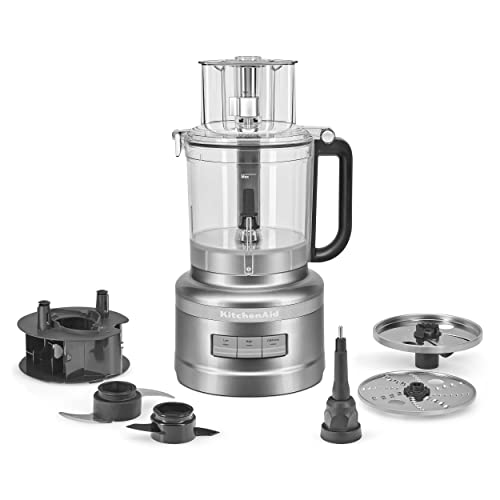
The KFP1318 has the largest bowl here at 13 cups, and it has the feature I would keep on a daily driver if I could pick one: the Exact Slice disc adjusts thickness with a lever on the outside of the bowl, so you do not stop and swap discs to move from thin cucumber to thick potato. KitchenAid also builds an in-bowl storage caddy so the blades and discs live with the machine, not in a drawer where one goes missing.
The trade-offs are size and weight. It weighs 9.7 lb and stands 17.4 x 8.7 x 10.3 in, the biggest base here in every dimension. It is also the most expensive pick in this set and it sells the slowest of the five. The accessory count is seven and the warranty is a stated 1 year. The 3-in-1 feed tube is the one detail that most rewards daily use: fewer pre-cuts, less prep.
If you cook for four or more most nights and have permanent counter space for it, this earns its keep. For a couple's daily prep, it is more machine than you need.
Pros:
- 13-cup bowl, the largest here
- Externally adjustable slicing disc
- In-bowl storage for seven accessories
- 3-in-1 feed tube for varied ingredient shapes
- Stated 1-year warranty
Cons:
- Heaviest at 9.7 lb
- Largest footprint at 17.4 x 8.7 x 10.3 in
- The most expensive pick here
- The slowest seller of the five
Bowl capacity: how much do you actually need?
Capacity is where daily use decisions get made, and most buyers overbuy.
Here is what the picks give you:
- 8 cup + 8 cup: Ganiza GC10 and GC10-S
- 9 cup (72 oz): Ninja BN601
- 10 cup: Hamilton Beach 70730
- 13 cup: KitchenAid KFP1318
For one or two people cooking dinner most nights, 8 cups is enough for a base of onion, carrot and celery, or for a batch of pesto. Twin 8-cup bowls beat a single 10-cup one for the way daily cooking actually runs, because the second bowl is dry and clean when you switch tasks.
For a household of four or more, or for meal prep on the weekend, the 10-cup Hamilton Beach or the 13-cup KitchenAid earns the counter space. The 13-cup only makes sense if you regularly fill it. A half-full processor bowl chops unevenly, so oversize is not free.
The Ninja 9-cup is the awkward middle: too big for one bowl of onions, not big enough to justify its footprint over the KitchenAid if you cook for a crowd.
Which one cleans up fastest?
Cleanup is where a daily driver earns its place, and the listings tell you more than you might expect.
The Hamilton Beach 70730 has the built-in scraper, which the brand says lets you clear the bowl walls without stopping. Fewer stops means fewer chances for food to weld itself to the blade shaft.
The two Ganiza models use a glass bowl and a stainless steel bowl. Neither stains. Both go in warm water without fogging or discolouring the way some plastic bowls do after a year of curry.
The Ninja BN601 and the KitchenAid KFP1318 use plastic bowls, which are lighter to lift but stain more with turmeric or tomato paste over time. The KitchenAid does have one cleanup advantage: the in-bowl caddy stores blades in the machine, so you are not chasing a slicing disc across a wet counter.
None of the five publishes explicit dishwasher-safe language in the data given, so treat handwashing as the safe assumption and confirm on the listing before you buy.
Ganiza GC10 vs KitchenAid KFP1318: which fits daily use?
The two ends of this shortlist go head to head cleanly.
The Ganiza GC10 weighs 5 lb, gives you 16 cups of total bowl capacity across two bowls, costs the least here and sells the fastest of the five. It has no published warranty and no adjustable slicing disc.
The KitchenAid KFP1318 weighs 9.7 lb, gives you 13 cups in a single bowl, costs the most, sells the slowest of the five and carries a stated 1-year warranty. It has an externally adjustable slicing disc, a 3-in-1 feed tube and seven stored accessories.
For daily use in a household of one to three, the GC10 wins on weight, on the second bowl and on price position. For daily use in a family of four or more who bake, the KFP1318 wins on capacity, accessories and the warranty.
The cutoff is roughly four people. Below it, the Ganiza. Above it, the KitchenAid.
The verdict
The best full size food processor for daily use is the Ganiza GC10. It gives you two 8-cup bowls in glass and stainless steel on a 5 lb base, which is the layout that matches the way daily cooking actually happens: one bowl for produce, one for meat, no wash between them. It costs the least in this set and it sells the fastest, and it fits under a standard cabinet at 11 x 6.95 x 8.85 in.
Two conditions flip the pick. If a stated warranty matters and you would rather have one 10-cup bowl than two 8-cup bowls, the Hamilton Beach 70730 is the buy, with a 1-year warranty, a slicing and shredding disc and a built-in scraper. If you cook for four or more most nights and bake regularly, the KitchenAid KFP1318 earns its 9.7 lb footprint through a 13-cup bowl and an adjustable slicing disc.
Skip the Ninja BN601 unless the preset programs and the dough blade describe your week. Skip the Ganiza GC10-S unless the overheat light is worth the step up from the GC10 to you.
FAQ
Is a full size food processor worth it for daily use?
A full size food processor is worth it for daily use if you prep vegetables, grind meat or make dough more than three or four times a week. The 8-cup twin-bowl Ganiza GC10 pays back on onions, celery, carrot and garlic prep alone. Below that frequency, a mini chopper takes less space and less cleanup, and the full size machine ends up in a cupboard.
What size food processor is best for a family of four?
A food processor for a family of four is best at 10 cups or larger. The Hamilton Beach 70730 at 10 cups handles a family salsa or a shredded coleslaw in one go. The KitchenAid KFP1318 at 13 cups adds room for dough and for double batches, though at 9.7 lb it needs a permanent home on the counter rather than a cupboard.
Is the Ganiza GC10 or the Ninja BN601 better for everyday cooking?
For everyday cooking, the Ganiza GC10 has the edge over the Ninja BN601 on two fronts: it gives you two 8-cup bowls rather than one 9-cup bowl, and its 5 lb base is 2.65 lb lighter to lift out and put back. The Ninja wins if you use its Auto-iQ presets and the included dough blade weekly, which is a narrower use case than daily vegetable prep.
Do you need 1000 watts in a food processor?
You do not need 1000 watts in a food processor for most daily use. Two picks here list 450W and handle chopping, shredding and slicing the same tasks the 1000 peak watt Ninja handles. Peak watts is a momentary maximum, not a sustained rating. Bowl capacity, weight and bowl material change the daily experience more than the wattage headline does.
What is the biggest mistake buyers make in this category?
The biggest mistake in this category is overbuying capacity. A half-full processor bowl chops unevenly because the blade throws food outward and away from itself. If you cook for one or two, 8 cups is enough, and twin 8-cup bowls beat a single 13-cup bowl on daily cleanup. Buy the size that matches your usual batch, not your largest imagined batch.
If you cook most nights and want the machine that fits that pattern with the least fuss, start with the Ganiza GC10. Two bowls, 5 lb, small footprint, cheapest here. Order it, use it for a week on your regular prep list, and you will know quickly whether 8 cups per bowl matches your batches. If it does not, the Hamilton Beach 70730 at 10 cups is the natural step up, and the KitchenAid KFP1318 at 13 cups is the answer for a bigger household. What matters for daily use is a machine light enough to move, easy enough to clean and sized to what you actually cook.