Best Food Processor for Off Grid Living: Ninja Leads

Six food processors compared on the two numbers that matter when your power comes from a battery bank: motor draw and bowl capacity. The Ninja BN601 wins, but a 350-watt chopper beats it on some days.

By Mckinley BirdUpdated 17 min read
On this page
- Best food processor for off grid living at a glance
- How I cut the field down to six
- Why wattage is the number that decides this
- 1. Ninja Professional Plus Food Processor — Best overall
- 2. Cuisinart Food Processor 14-Cup — Best premium
- 3. Ganiza Food Processors with 2 Bowls — Best for families
- 4. Ganiza Food Processor with Dual Bowls — Best upgrade
- 5. Cuisinart Mini Food Processor — Most versatile
- 6. Hamilton Beach 3 Cup Electric Vegetable Chopper — Best budget pick
- How much bowl do you actually need?
- Can any of these run off a small inverter?
- What the listings do not tell you
- The verdict
- FAQ
The best food processor for off grid living is the Ninja Professional Plus BN601, because its 1000 peak watts and 72 oz bowl let you finish a batch in one short burst instead of five long ones. If your power system can't absorb that spike, the Hamilton Beach 3 Cup chopper draws a listed 350 watts and weighs 2.1 lb. Motor draw is what splits this field. Everything else — bowl material, blade count, preset programs — is downstream of whether your system can start the motor at all.
Best food processor for off grid living at a glance
| Pick | Bowl capacity | Motor (listed) | Price |
|---|---|---|---|
Best overall Ninja Professional Plus Food Processor |
72 oz (9 cup) | 1000 peak watts | Check Price |
Best premium Cuisinart Food Processor 14-Cup |
14 cup | 720 watts | Check Price |
Best for families Ganiza Food Processors with 2 Bowls |
8 cup + 8 cup | 450 watts | Check Price |
Best upgrade Ganiza Food Processor with Dual Bowls |
8 cup + 8 cup | 2-speed, wattage not listed | Check Price |
Most versatile Cuisinart Mini Food Processor |
3 cup (24 oz) | 250 watts | Check Price |
Best budget pick Hamilton Beach 3 Cup Electric Vegetable Chopper |
3 cup | 350 watts | Check Price |



How I cut the field down to six
Three things got listings dropped before I compared anything.
The first was a missing wattage figure. If neither the specifications nor the manufacturer's own bullets name a motor rating, the listing is useless to anyone sizing an inverter. That cut a long tail of unbranded choppers. One of the six survivors, the newer Ganiza GC10-S, made it through on the strength of sharing a platform and a bowl set with its listed 450-watt sibling, and I've flagged that gap in its section rather than papering over it.
The second was ambiguous capacity. "Large bowl" is not a number. Every pick here states its bowl in cups or ounces, so you can line them up: 3 cup, 3 cup, 8 cup plus 8 cup, 8 cup plus 8 cup, 9 cup, 14 cup.
The third was weight with no dimensions, or dimensions with no weight. Shelf space and lifting effort both matter when the appliance lives in a cabin, a van or a trailer instead of a fitted kitchen. All six list both.
What survived is a spread, not a cluster. The lightest listed unit is a fraction of the heaviest at 18 lb. The published motor ratings run from 250 watts to 1000 peak watts. That range is deliberate, because the right food processor for off grid living depends entirely on the size of the system feeding it.
Why wattage is the number that decides this
Most guides to the best food processor for off grid living rank on bowl size. Bowl size decides how many passes you make. Wattage decides whether the machine runs at all.
Two figures do the work here:
- Continuous draw, which is what the listed watts describe. A 250-watt motor and a 1000-peak-watt motor are not in the same conversation for a small battery bank.
- Startup surge, the brief spike as a motor spins up from stopped. It's higher than the running figure, and it's why an inverter that comfortably handles a rated load can still trip.
Neither number is published as a surge figure on any of these six listings, so treat the rated watts as a floor and not a ceiling. That single fact reframes the whole category.
Here's the trick with a big motor on a modest system: it isn't the peak that hurts, it's the duration. A 1000-peak-watt Ninja that turns 9 cups of vegetables into a uniform dice in fifteen seconds may draw less total energy than a 350-watt chopper you pulse forty times. Watt-hours are the currency, not watts. That's the case for the Ninja, and it's also why the case has a limit: if your inverter can't start the motor, no efficiency argument helps.
Three things I'd check on your own setup before buying:
- Your inverter's continuous rating, in watts.
- Its surge rating, and for how many seconds it holds.
- Whether it's a pure sine wave unit, because motor-driven appliances are fussier than resistive loads.
1. Ninja Professional Plus Food Processor — Best overall
The 1000-peak-watt motor and 72 oz bowl mean one short burst does the work of several passes, which is the right shape of power draw for a battery bank.
Best for: batch prep for a household, when the power budget allows a big draw in short bursts Skip it if: counter and shelf space are both tight
Within this set, the BN601 has the highest published motor rating at 1000 peak watts and the second-largest bowl at 72 oz. That combination is what separates it. Ninja says the four Auto-iQ preset programs cover chopping, slicing, pureeing and dough, and the listing states a dough blade is included alongside the stainless precision blades. Preset programs matter more than they sound off grid, because a timed program stops on its own instead of running while you decide it's done.
It weighs 7.65 lb, roughly 40% of the heaviest pick here, and measures 16 x 9.88 x 7.76 in. That 16-inch height is the real constraint. It won't slide under a low cabinet, and in a compact galley it becomes a shelf resident rather than a countertop one. The stated warranty runs one year, shorter than the Cuisinart mini at 18 months.
The trade-off against the rest of this set is straightforward: you're accepting the biggest motor rating and the second-highest price position in exchange for finishing faster. If your system can't start it, none of that matters.
Pros:
- Highest published motor rating here at 1000 peak watts
- 72 oz bowl, second-largest in this set
- Four Auto-iQ preset programs claimed
- Dough blade included per the listing
- Sells faster than every other full-size pick here
Cons:
- 16 in tall, awkward under low cabinets
- One-year warranty, shorter than the Cuisinart mini
- Highest startup demand of the six
- Second-highest price position in this set
2. Cuisinart Food Processor 14-Cup — Best premium
The largest bowl in the set at 14 cups, with slicing and shredding discs included and the longest stated warranty coverage, but 18 lb of it.
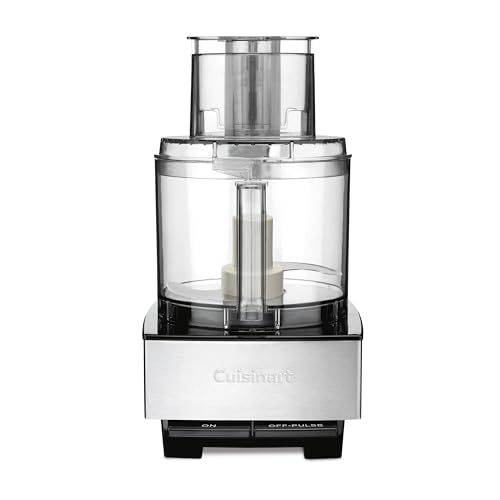
Best for: serious volume cooking with slicing and shredding discs included Skip it if: you have to lift it on and off a shelf
This is the capacity pick. At 14 cups it holds more than any other bowl here, and it's the only one of the six whose listing names included discs: a 4mm stainless standard slicing disc, a medium shredding disc, and a chopping/mixing blade. For anyone putting up a garden harvest, the shredding disc is the feature that changes an afternoon.
The 720-watt motor sits below the Ninja's peak figure but well above everything else with a published rating. Cuisinart states a limited three-year warranty on the unit and a full five-year warranty on the motor, the longest coverage in this set by a wide margin. The listing also notes the slicing and shredding blades are not adjustable, so you get one thickness each.
Then the weight: 18 lb, more than double the Ninja and roughly eight times the lightest picks here. Footprint is 14.8 x 11 x 7.9 in, which is wide but low enough to live under most cabinets. Against the rest of the set it trades portability for throughput, and it's the most expensive pick here. It also moves slowest of the six.
Pros:
- Largest bowl in this set at 14 cups
- Only pick with slicing and shredding discs named in the listing
- Three-year unit and five-year motor warranty claimed
- Extra-large feed tube with two pusher sizes
- Under 8 in tall, fits below most cabinets
Cons:
- 18 lb, the heaviest pick by a large margin
- Slicing and shredding discs are not adjustable
- The most expensive pick here
- Slowest seller of the six
3. Ganiza Food Processors with 2 Bowls — Best for families
Two 8-cup bowls in glass and stainless steel on a listed 450-watt motor, which is the most capacity per watt in this comparison.
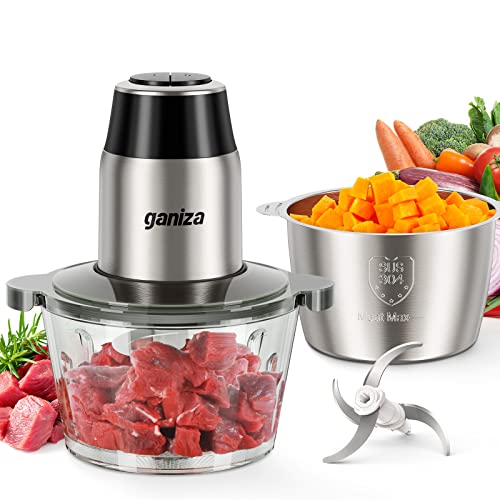
Best for: two-bowl prep at a lower motor draw Skip it if: you need a published warranty
Run the arithmetic across the set and this one comes out ahead on efficiency: 16 cups of total bowl capacity on a listed 450 watts. Ganiza pairs an 8-cup glass bowl with an 8-cup 304 stainless bowl and two sets of blades, and says the material split is there so raw meat and vegetables never share a container. On a homestead where you're grinding your own meat, that's a genuine hygiene argument rather than a marketing one.
It weighs 5 lb and measures 11 x 6.95 x 8.85 in, so it sits between the mini choppers and the full-size machines on both counts. The listing claims a full-copper motor with three times the service life of a regular motor, and an overheat protection system that stops the machine until it cools. Take the copper claim as the manufacturer's, not a measured figure. The overheat cutout is worth knowing about before it surprises you mid-batch.
Two gaps stand out. No warranty appears in the specifications, unlike four of the six picks here. And only one seller lists it, which narrows your options if anything goes wrong.
Pros:
- 16 cups of total bowl capacity on 450 listed watts
- Glass and stainless bowls separate raw meat from produce
- Two blade sets included per the listing
- 5 lb, lighter than both full-size picks
- Overheat protection system claimed
Cons:
- No warranty stated in the listing
- Only one seller stocks it
- Overheat cutout means waiting mid-batch
- Two speeds only, no preset programs
4. Ganiza Food Processor with Dual Bowls — Best upgrade
The same dual 8-cup bowl setup with a redesigned button and an overheat indicator light, though its listing publishes less than its predecessor's.

Best for: someone who wants the dual-bowl setup with a clearer overheat readout Skip it if: you want a listing with complete published specifications
The GC10-S is the newer sibling of the GC10 above, and the differences the listing names are worth something. Ganiza claims a patented button design that presses more easily, and an overheat protection light display rather than a silent cutout. A light that warns you before the motor stops is a real improvement when you're mid-task and can't just plug in a backup.
Bowls are the same pairing: 8-cup glass and 8-cup 304 stainless, with two blade sets. Dimensions are 13 x 8 x 7 in, a little wider than the GC10 but under 8 in tall. Two speeds, no presets.
Here's where I'd be honest with you. This listing doesn't publish a wattage figure, and its stated weight of 3.53 oz can't describe a two-bowl food processor with a motor base. Neither is a reason to avoid the machine, but both are reasons to check the current listing yourself before you commit, especially if you're sizing an inverter around it. No warranty is stated either. Against the GC10, you're paying a step up in price position for an indicator light and a better button, with less published information to go on.
Pros:
- Dual 8-cup glass and stainless bowls with two blade sets
- Overheat protection light display claimed
- Redesigned button described as easier to press
- Under 8 in tall, fits under most cabinets
Cons:
- No motor wattage published in the listing
- Stated weight figure does not match the product
- No warranty stated
- Higher price position than the GC10 for the same bowls
5. Cuisinart Mini Food Processor — Most versatile
A 250-watt motor with a reversible chop-and-grind blade, the lowest published draw here and the longest warranty among the small picks.

Best for: herbs, garlic, hard cheese and small-batch dressings Skip it if: you process more than 3 cups at a time
At 250 watts this is the gentlest load in the comparison, which makes it the easiest to run on a small system or a portable power station. The mechanism is what earns it the versatile label: Cuisinart describes a patented reversible stainless blade with auto-reversing SmartPower, giving a sharp edge for chopping and a blunt edge for grinding. One blade, two jobs, and no second attachment to store. For grinding hard cheese or spices, the blunt side does something the other picks in this set do not claim.
Capacity is 3 cups, or 24 oz. It weighs 2.2 lb and measures 9.25 x 5 x 7 in, so it lives in a drawer rather than on a shelf. The body is described as lightweight plastic in brushed chrome finish, with push-button control and a dishwasher-safe bowl and lid. Warranty is a limited 18 months, longer than the Ninja's stated year.
The trade-off is volume. Three cups is a fifth of the Cuisinart 14-cup bowl, so a large batch means repeated loads and repeated emptying. It also sits mid-range in price for the smallest capacity here.
Pros:
- Lowest published draw at 250 watts
- Reversible blade covers chopping and grinding
- 2.2 lb, easy to store in a drawer
- 18-month warranty, longer than the Ninja's
- Dishwasher-safe bowl and lid
Cons:
- 3-cup bowl means repeated batches
- Mid-range price for the smallest capacity here
- Push-button control, no timed programs
- Plastic body rather than metal
6. Hamilton Beach 3 Cup Electric Vegetable Chopper — Best budget pick
The lightest and cheapest pick here at 2.1 lb, with a press-to-run lid that means no switch to leave on.
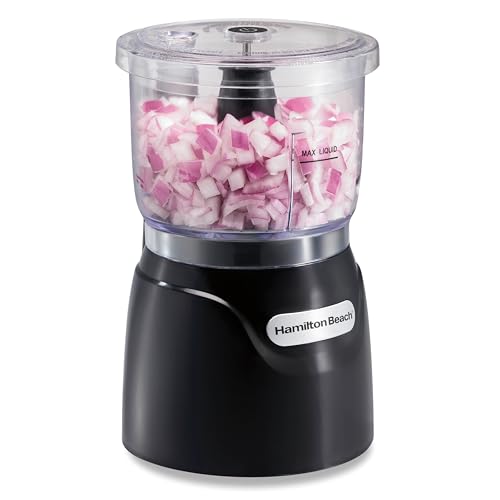
Best for: the lightest possible daily chopper on a small power system Skip it if: you want speed settings or preset programs
This is the cheapest of the six and the lightest at 2.1 lb, with a footprint of 8.54 x 5.9 x 5.2 in. It's also the one buyers choose most often here by a clear margin, which tells you the simple ones sell. Hamilton Beach describes a patented stack-and-press design: you press the lid to chop and release to stop. That's a meaningful safety property away from the grid, because a lid you hold cannot be left running while you turn away.
The motor is listed at 350 watts, above the Cuisinart mini and well below everything full size. Capacity is 3 cups, with stainless blades the listing says handle onions, carrots and nuts. Bowl, lid and removable blades are all described as dishwasher safe. Warranty is stated as one year.
Against the rest of the set, you give up control. There are no speeds, no presets, no timer, and no second bowl. Every task is you pressing a lid and judging texture by eye. For onions and herbs that's fine. For anything that wants a consistent puree, the press-and-release action fights you, and the 3-cup bowl caps the batch. It's the smallest tool here, and it knows it.
Pros:
- Lightest pick in the set at 2.1 lb
- Cheapest of the six
- Press-to-run lid cannot be left running
- Bowl, lid and blades all dishwasher safe
- The one buyers choose most often here
Cons:
- No speed settings or presets at all
- 3-cup bowl limits batch size
- Manual pressing makes even texture harder
- Smallest footprint comes with the smallest capability
How much bowl do you actually need?
Bowl capacity in this set spans nearly five to one, so it's worth being honest about your batches.
- 3 cups covers herbs, garlic, one onion, a small dressing, hard cheese. Both mini picks sit here.
- 8 cups, doubled is the Ganiza approach: two separate 8-cup bowls, so you prep in one and grind in the other without washing between.
- 72 oz, or 9 cups is the Ninja, and it's enough for a family batch in one pass.
- 14 cups is the Cuisinart DFP-14BCNY, and it's the one that makes sense if you're processing a harvest rather than a meal.
The off grid wrinkle is that a bigger bowl often costs less energy, not more. Filling a 14-cup bowl once and running for twenty seconds beats filling a 3-cup bowl five times and running for two minutes total, because the motor spends less time spinning. Startup surges are also a factor: five separate starts is five surges.
Weight cuts the other way. The 14-cup Cuisinart is 18 lb. If it lives on a shelf you reach above your head, you will use it less than you planned, and an appliance you avoid saves no energy at all. That tension between capacity and handling is the real decision in a food processor for off grid living.
Can any of these run off a small inverter?
Most shoppers miss that a rated wattage is not a startup wattage. None of these six listings publishes a surge figure, so the only responsible answer is to compare rated draws and leave headroom.
Sorted by published rating, lowest first: 250 watts for the Cuisinart mini, 350 for the Hamilton Beach, 450 for the Ganiza GC10, 720 for the Cuisinart 14-cup, and 1000 peak watts for the Ninja. The Ganiza GC10-S doesn't state one.
A few practical notes:
- "Peak watts" is not continuous watts. The Ninja's 1000-watt figure is a peak specification, so its continuous draw is lower. Ninja doesn't publish that lower number.
- Motors want pure sine wave power. Modified sine wave inverters run resistive loads happily and treat motors less kindly.
- Short bursts beat long grinding. The Ninja's preset programs and the Hamilton Beach's press-to-run lid both push you toward brief runs, for different reasons.
- Overheat protection changes your workflow. Both Ganiza picks claim a cutout that pauses the machine until it cools, which is protective but interrupts a batch.
I'd size any inverter well above the rated figure rather than at it. If your system is genuinely small, the 250-watt Cuisinart mini is the lowest-risk entry point in this set, and the 350-watt Hamilton Beach is barely a step up.
What the listings do not tell you
Four gaps run across all six of these product pages.
Startup surge. Discussed above, and absent everywhere.
Noise. No decibel figure appears on any of the six. In a cabin or a van, where a running motor fills the whole space, that's a real unknown.
Replacement parts. Bowls crack and blades dull. Only the Cuisinart 14-cup names its included discs specifically enough that you'd know what to reorder. For the rest, you're working from a model number: BN601, 72850G, GC10, DLC-2ABC, GC10-S.
Warranty completeness. Four of the six state something. Cuisinart's 14-cup claims three years on the unit and five on the motor, the mini claims 18 months, the Ninja states one year, and the Hamilton Beach states one year. Neither Ganiza listing states a warranty at all, and that gap matters more when your nearest service option is a shipping label.
One more thing worth naming: bowl material is disclosed unevenly. Ganiza specifies glass and 304 stainless. Cuisinart's mini describes a lightweight plastic body and a BPA-free bowl. The Ninja and the Hamilton Beach describe stainless blades without describing the bowl. If material matters to you, check the current listing.
The verdict
The Ninja Professional Plus BN601 is the best food processor for off grid living, and the reason is duration rather than power. A 1000-peak-watt motor working a 72 oz bowl finishes a batch in one short run, which draws fewer watt-hours than pulsing a small chopper twenty times, and the four Auto-iQ programs stop on their own instead of running while you decide.
Two conditions flip that recommendation.
The first is inverter capacity. If your system can't reliably start a 1000-peak-watt motor, the argument collapses, and the Hamilton Beach 3 Cup chopper at a listed 350 watts and 2.1 lb becomes the right buy. It's the cheapest pick here and the one buyers choose most often in this set.
The second is volume. If you're putting up a garden rather than making dinner, the Cuisinart DFP-14BCNY's 14-cup bowl and its named 4mm slicing and medium shredding discs do work the Ninja can't match with a chopping blade. Its advantage is precise: the discs, and a stated three-year unit and five-year motor warranty. The cost is 18 lb of appliance to lift.
Between the two extremes, the Ganiza GC10 is the efficiency play, with 16 cups of total bowl capacity on a listed 450 watts and no warranty published.
FAQ
Is a food processor worth the power draw off grid?
A food processor is worth the power draw if you're processing more than a couple of cups at a time. Twenty seconds at 720 watts is a fraction of a watt-hour. A knife costs nothing, but grinding meat or shredding cabbage by hand costs time you may want back. Below 3 cups per session, the knife usually wins.
Which uses less energy, the Ninja BN601 or the Hamilton Beach chopper?
Between the Ninja BN601 and the Hamilton Beach, the Ninja's 1000 peak watts sounds worse and often isn't. Its 72 oz bowl and preset programs finish in one short burst, while the 350-watt Hamilton Beach needs repeated pressing on a 3-cup bowl. Total watt-hours favour the Ninja on large batches. The Hamilton Beach wins on small ones and on inverter headroom.
Do any of these fit under a standard kitchen cabinet?
Fitting under a standard cabinet rules out one pick. The Ninja BN601 stands 16 in tall and needs open space above. The Cuisinart 14-cup is 7.9 in, the Ganiza GC10-S is 7 in, the Cuisinart mini is 7 in, the Ganiza GC10 is 8.85 in, and the Hamilton Beach is 5.2 in. All five clear most cabinets comfortably.
What size food processor do I need for a household of four?
For a household of four, 8 cups or more saves you from repeat batches. The Ninja's 72 oz bowl handles a family meal in one pass, and the two Ganiza models give you 8 cups twice over in separate glass and stainless bowls. The 3-cup picks are for herbs and dressings, not dinner for four.
What is the most common mistake buying a food processor for off grid living?
The most common mistake buying for off grid use is matching a motor's rated watts to an inverter's rated watts with no headroom. Motors surge on startup, and none of these listings publishes that surge figure. Size the inverter above the rated draw, and prefer pure sine wave output, which motor-driven appliances handle far better than modified sine wave.
Start with the number on your inverter, not the number on the box. If it comfortably clears 1000 watts with surge headroom, the Ninja BN601 is the default: one 72 oz bowl, one short run, four programs that stop themselves. If it doesn't, drop to the 350-watt Hamilton Beach and accept more passes. And if your cooking is seasonal volume rather than daily meals, the 14-cup Cuisinart with its slicing and shredding discs is the machine that changes what you can put up. Check the current listing for wattage before you buy either Ganiza.