Best Electric Skillet for Off-Grid Cooks and Cabins

Five electric skillets sized up for cabin kitchens, solar setups and generator power. Wattage, weight and pan depth ranked, with the trade-offs named.

By Mckinley BirdUpdated 14 min read
On this page
- How I screened the field down to five
- Best electric skillet for off grid living at a glance
- Does an electric skillet really suit off-grid living?
- Watts, inverters and what your power system can spare
- 1. Elite Gourmet 12" PFAS-Free Ceramic Electric Skillet — Best overall
- 2. Elite Gourmet 10.5Qt Nonstick Electric Skillet — Runner-up
- 3. MIOAOTCE 16" Extra Large Electric Skillet with Lid — Best for beginners
- 4. Chefman XL Electric Griddle — Best budget pick
- 5. Presto 06857 16-Inch Electric Foldaway Skillet — Best premium
- What to check on the listing before you buy
- Head-to-head: Elite Gourmet EG2313 vs Presto 06857
- The verdict
- FAQ
The best electric skillet for off grid living is the Elite Gourmet EG2313, a 12-inch ceramic pan rated at 1200W with 3-inch sidewalls that keeps power draw modest while still braising, searing and stir-frying for four. The Presto 06857 is the alternate pick when you need a 16-inch surface and the ability to fold the base into the pan for compact storage between trips.
Most guides to the best electric skillet for off grid living compare cooking surface first. That is the wrong lead. Off-grid, the number that decides the pan is watts, because watts multiplied by minutes is what your battery bank, your generator run-time or your inverter has to hand over. A 1500W pan for 20 minutes is 500Wh. A 1200W pan doing the same job in the same time is 400Wh. On a small solar system that 100Wh gap is a real evening.
How I screened the field down to five
I started with the electric skillets and one large electric griddle that publish enough on the listing to be useful for an off-grid buyer: wattage where stated, weight, dimensions, temperature range, and whether the base is removable for cleaning without water pressure. Anything without a published weight or a stated temperature range got cut, because both matter when you are hauling gear to a cabin and cooking on a limited power budget.
Three criteria decided the ranking, in this order:
- Power draw against typical off-grid inverter sizing. Lower watts wins where the cooking job is the same.
- Pan depth and surface area, because a deep pan does more jobs and reduces the number of appliances you need to store.
- Weight and storage footprint, since cabin kitchens and RV galleys punish anything bulky.
I did not use ratings, review counts or buyer feedback of any kind. The data I worked from was the manufacturer's published specifications and the position of each pick against the others in this set on price and sales.
One caveat worth naming upfront: Amazon's search for "off grid" electric skillets returns general-purpose skillets, not skillets specifically engineered for off-grid systems. No product here is marketed as off-grid gear. The judgment is mine, based on the numbers each listing publishes.
Best electric skillet for off grid living at a glance
| Pick | Power / Size | Depth & weight | Price |
|---|---|---|---|
Best overall Elite Gourmet EG2313 |
1200W claim 12 in / 7.5 Qt |
3 in walls 6.11 lb |
Check Price |
Runner-up Elite Gourmet EG-6203 |
Not stated 16 x 13 in / 10.5 Qt |
3.15 in walls 10.5 lb |
Check Price |
Best for beginners MIOAOTCE AD-P42S |
1500W claim 16 in / 9.3 Qt |
5 dial settings Weight not listed |
Check Price |
Best budget pick Chefman XL Griddle |
Not stated 10 x 20 in flat |
Flat top 4.4 lb |
Check Price |
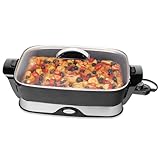
Best premium Presto 06857 |
Not stated 16 in |
High sidewalls 8.55 lb |
Check Price |


Does an electric skillet really suit off-grid living?
Depends on your power system, and the honest answer is that a resistive cooker is one of the harder loads a small off-grid setup takes on. An electric skillet pulling 1200W for 30 minutes is 600Wh. That is roughly a quarter of a 2.4kWh lithium bank at 100% depth of discharge, or a fifth of a 3kWh bank. On a generator, it is 30 minutes of run-time you may not want to spend on dinner.
Where these pans earn their place is on hybrid setups: a cabin with solar plus a generator, an RV plugged into shore power at a campsite, or a homestead where the daytime array covers midday cooking directly. Cook in the sun, not off the battery, and the numbers change entirely. The pan becomes a way to keep the propane cooktop free and the kitchen cool in summer.
If your only power is a 300W portable station, none of the pans in this set will run cleanly. That is a physics problem, not a product problem.
Watts, inverters and what your power system can spare
The number the listings give you, when they give it, is the maximum draw. That is the number your inverter has to hold, continuously, for as long as the thermostat says heat. Undersize the inverter and you will trip it the first time the pan cycles on.
Practical sizing, using the two wattage figures published in this set:
- A 1200W pan (Elite Gourmet EG2313 claim) wants a pure sine wave inverter rated at 2000W continuous. That gives you the headroom for the startup surge and any parasitic loads on the same circuit.
- A 1500W pan (MIOAOTCE AD-P42S claim) wants a 2500W to 3000W continuous inverter for the same reason.
- A pan with no published wattage is a pan you cannot size for. Assume 1500W and plan on the safe side, or pick one of the two above.
The thermostat cycles the element on and off, so average draw over a full cook is lower than the peak. But the inverter has to hold the peak, not the average, and that is the number that fails cheap gear.
1. Elite Gourmet 12" PFAS-Free Ceramic Electric Skillet — Best overall
A modest 1200W draw, real 3-inch walls and a PFAS-free coating make this the most off-grid-friendly pan of the five.
Best for: cabin cooks feeding four on a modest inverter Skip it if: you need a 16-inch surface for pancakes in bulk
The EG2313 wins on the number that matters most on a battery-fed kitchen. Elite Gourmet lists it at 1200W, the lowest published draw in this set, which lines up with a 2000W continuous inverter and leaves headroom for a fridge cycling on the same bank. The pan measures 12 inches across with 3-inch sidewalls, and the whole unit weighs 6.11 lb. That is light enough to lift full, and small enough to store in a cabin cupboard.
The Ceralast ceramic coating is PFAS-free and PTFE-free by the manufacturer's description, which matters more off-grid than in a city kitchen: you cannot replace a scratched pan on a Tuesday when you are two hours from a hardware store. Elite Gourmet claims a 200 to 400°F thermostat range and says both the pan and the lid are dishwasher safe once the probe is removed.
The trade-off is capacity. At 7.5 quarts it will feed four, not eight, and if your household runs bigger the runner-up is the right call.
Pros:
- Lowest published wattage in this set at 1200W
- 3-inch sidewalls handle braises and stir-fries
- Light at 6.11 lb, easy to pack and store
- PFAS-free and PTFE-free coating claim
- Full 200 to 400°F thermostat range
Cons:
- Smaller surface than the 16-inch picks
- Only two sellers list it, so stock can be thin
- No published warranty on the listing
2. Elite Gourmet 10.5Qt Nonstick Electric Skillet — Runner-up
A 10.5-quart family pan with 3.15-inch walls that swaps low weight for real capacity.

Best for: larger households wanting one-pan family meals Skip it if: storage space is at a premium
The EG-6203 is the pan you pick when the household is six to eight, which is what Elite Gourmet says it feeds. The cooking area is 16 by 13 inches, the sidewalls are 3.15 inches, and the total quart capacity is 10.5. That is enough to build a full one-pan casserole or fry a batch of pancakes for a full breakfast run without doing it in shifts.
Elite Gourmet describes a fully embedded M-shaped heating element covering the whole pan floor, which the listing frames as its answer to hot spots. The nonstick surface is a marbleized stone-finish coating rather than the PFAS-free ceramic of the winner, and the listing does not publish a wattage figure. That is the honest weakness here: without a stated draw, you cannot size your inverter with confidence, and off-grid that is not a small gap.
Against the winner, this pan trades weight and footprint for capacity. It is 10.5 lb versus 6.11, and the base is 16 inches across. If you are cooking for four, the winner does the job with less power and less bulk. If you are cooking for eight, this one earns the space.
Pros:
- 10.5-quart capacity for six to eight people
- Deep 3.15-inch sidewalls for braises
- Embedded M-shaped heating element claim
- Dishwasher safe once the probe is removed
- Second-cheapest of the five
Cons:
- No published wattage on the listing
- 10.5 lb is the heaviest full skillet here
- Big footprint eats cabin cupboard space
3. MIOAOTCE 16" Extra Large Electric Skillet with Lid — Best for beginners
A simple 5-setting dial and a 16-inch pan make this the easiest pick to learn on, if your inverter can hold 1500W.

Best for: first-time buyers who want simple dial control Skip it if: your inverter cannot hold 1500W cleanly
The MIOAOTCE AD-P42S trades continuous thermostat control for five preset heat settings on a detachable dial. That is a beginner-friendly choice: instead of guessing at 340°F, you turn the dial to setting three. MIOAOTCE claims 1500W, which is the highest published draw in this set, and pairs it with a 16 by 16.6-inch footprint and a 9.3-quart capacity. The manufacturer lists cool-touch handles and a tempered glass lid.
The listing does not publish a weight, which is the reason this is not ranked higher. For off-grid buyers weight and inverter sizing are the two decisions you make before you cook, and this pan gives you neither number directly. The 1500W figure means a 2500W to 3000W continuous inverter, which is a bigger system than the winner asks for.
Against the field, the appeal is the simplicity. Five settings, one dial, a big pan. If you are new to electric skillets and want to learn without staring at a thermostat, the trade-off is defensible. The premium price position for a pan without a published weight is harder to defend.
Pros:
- Five preset heat settings on a detachable dial
- 16-inch pan with 9.3-quart capacity
- Cool-touch handles per the listing
- Tempered glass lid included
- Ceramic nonstick coating claim
Cons:
- 1500W is the highest published draw here
- No published weight on the listing
- Only one seller listed, so stock is thin
- Premium price position for limited specifications
4. Chefman XL Electric Griddle — Best budget pick
A 4.4-lb flat-top griddle that is the lightest and cheapest pick here, if you can live without sidewalls.

Best for: solo cooks who mainly want a flat griddle surface Skip it if: you cook stews, braises or anything with sauce
The Chefman RJ23-LG-V3 is the outlier in this set: an electric griddle rather than a skillet, listed under a different category and included here because it solves an adjacent problem. The 10 by 20-inch flat surface, the 4.4 lb weight and the cheapest price position in this set make it the easiest pan to justify if you already have a pot for wet cooking and need something for breakfast, burgers and quesadillas.
Chefman lists a 200 to 420°F temperature range, a removable probe, a slide-out drip tray and a fully immersible cook top for cleaning without dismantling the electrics. There is a 1-year warranty, one of only two picks in this set with a published warranty. The listing does not state wattage, so inverter sizing is guesswork.
The flat top is the honest limit. No sidewalls means no braising, no soup, no anything wetter than eggs. If your off-grid cooking is dry-heat and one pan, this is the lightest and simplest pick. If it is not, one of the skillets does more jobs for a small weight penalty.
Pros:
- Lightest pick at 4.4 lb
- Cheapest of the five
- 200 to 420°F temperature range
- 1-year warranty published
- Slide-out drip tray for grease
Cons:
- Flat top, no sidewalls for wet cooking
- No published wattage
- It is a griddle, not a skillet
- Different category to the other picks
5. Presto 06857 16-Inch Electric Foldaway Skillet — Best premium
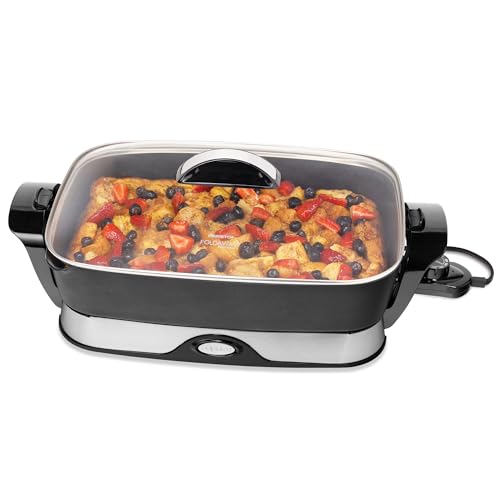
A 16-inch skillet whose handles fold and base detaches so the whole thing packs inside itself for storage.
Best for: seasonal cabins where storage matters more than weight Skip it if: you want the newest nonstick chemistry
The Presto 06857 solves a problem the other picks do not address: storage between visits. The handles fold down, the base detaches, and with the handles folded in the base fits inside the pan itself. For a cabin that gets closed up between trips, or an RV where cupboard space is measured in inches, that is a real design win.
The pan is 16 inches with high sidewalls, weighs 8.55 lb, and comes with a 1-year limited warranty. Presto describes it as capable of roasting, frying, grilling, stewing, baking and casserole work, which puts it in the same job category as the two Elite Gourmet skillets. The listing does not publish a wattage or a temperature range in the specifications block, which is the weakness here.
Against the field, this is the pick when the pan spends more time stored than cooking. Against the winner, you get a bigger pan and the foldaway trick, at the cost of a heavier body, the highest price position in this set and an older design that predates the PFAS-free coating on the EG2313.
Pros:
- Handles fold and base detaches for storage
- 16-inch pan with high sidewalls
- 1-year limited warranty
- Base fits inside the pan for compact storage
- Roast, fry, grill, stew and bake per the listing
Cons:
- No wattage published on the listing
- Older design, no PFAS-free claim
- Most expensive pick in this set
- Slowest seller of the five
What to check on the listing before you buy
Off-grid buyers need three numbers the general shopper can ignore. Check every listing for these before you commit:
- Wattage. Only two of the five picks in this set publish one. If the number is missing, assume 1500W and size your inverter accordingly.
- Weight. Two of the five omit this. If you are hauling gear up a track or into a boat, it matters.
- Temperature range and probe removal. A removable probe means you can wash the pan without dismantling the electrics, which matters when your dishwater came from a jerry can.
Two more listing details reward a second look. The first is coating chemistry: PFAS-free ceramic (as the EG2313 claims) versus generic nonstick. The second is warranty length. Only the Chefman griddle and the Presto skillet publish one in this set, both at 1 year. That is a smaller detail than wattage, but off-grid you value replaceability.
Head-to-head: Elite Gourmet EG2313 vs Presto 06857
These are the two skillets in this set that solve genuine off-grid problems, and they solve different ones. The EG2313 is the low-draw daily driver: 1200W claimed, 6.11 lb, PFAS-free ceramic coating, a 200 to 400°F thermostat and a 12-inch surface. It is the pan you use every night in a cabin with a modest inverter.
The Presto 06857 is the seasonal-storage specialist: 16 inches across, 8.55 lb, foldaway handles and a base that packs inside the pan. It is the pan you use every night at a cabin you visit twice a year, then break down and stow.
If you cook daily on battery power, take the winner. If the pan spends nine months in a cupboard and three months in service, the Presto's storage design earns its higher price position.
The verdict
The Elite Gourmet EG2313 is the best electric skillet for off grid living because it publishes the lowest wattage in this set at 1200W, weighs only 6.11 lb, offers 3-inch sidewalls for real one-pan cooking, and pairs that with a PFAS-free ceramic coating you cannot easily replace off-grid. The whole package sizes cleanly to a 2000W continuous inverter, which is a realistic target for a cabin or a well-specced RV.
Two conditions flip the recommendation. First, household size: if you are cooking for six to eight, the Elite Gourmet EG-6203 with its 10.5-quart capacity and 3.15-inch walls does the job the winner cannot, at the cost of published wattage and 4 lb of extra weight. Second, storage pattern: if the pan lives in a cupboard between seasonal visits, the Presto 06857's foldaway handles and self-storing base are worth the higher price position.
None of the picks are engineered as off-grid gear. All of them are general-purpose skillets whose specifications happen to align, to varying degrees, with off-grid needs. The winner aligns most closely because it publishes the numbers that matter and keeps them modest.
FAQ
What size inverter do I need for an electric skillet off-grid?
What size inverter you need depends on the pan's continuous wattage plus a headroom margin. A 1200W skillet like the Elite Gourmet EG2313 wants a 2000W continuous pure sine wave inverter. A 1500W pan like the MIOAOTCE wants 2500W to 3000W continuous. Pans that do not publish a wattage should be sized as if they draw 1500W, so plan for the larger inverter.
Is an electric skillet worth it for off-grid living?
An electric skillet is worth it if your power system can cover 400 to 600Wh per cooking session without draining the bank below its comfortable depth of discharge. On a solar-plus-generator hybrid, cooking during peak sun keeps the pan effectively free. On a small 300W portable station, none of the pans in this set will run, and propane is the better answer.
Can I run the MIOAOTCE 16-inch skillet on a small solar system?
Can I run the MIOAOTCE cleanly on a small system, probably not. The listing claims 1500W, which is the highest published draw among these five picks. That translates to 500Wh for a 20-minute cook, which is a heavy hit on a 2kWh bank. A 3000W continuous inverter and a 4kWh or larger bank make it workable.
Elite Gourmet EG2313 vs Presto 06857: which suits a small cabin?
Elite Gourmet EG2313 vs Presto 06857 comes down to daily use versus seasonal storage. The EG2313 is 6.11 lb, publishes 1200W and has a PFAS-free ceramic coating, which suits a cabin where you cook nightly. The Presto is 16 inches, weighs 8.55 lb and folds into itself for storage, which suits a cabin closed up for months at a time.
What is the biggest mistake off-grid buyers make with electric skillets?
The biggest mistake off-grid buyers make is picking on cooking surface first, wattage second. A 16-inch pan that draws 1500W is a heavier load than a 12-inch pan at 1200W, every single meal. The right order is inverter capacity, then wattage, then surface area, then weight. Buy the pan your power system can hold, not the pan that looks impressive on the counter.
Start with your inverter, not the pan. Write down the continuous wattage rating on your inverter, subtract 500W for headroom and any parasitic loads, and buy the largest electric skillet whose published draw stays under that number. For most cabin systems that lands on the Elite Gourmet EG2313, which is why it takes the top pick here. If your inverter is bigger and your household is bigger, the EG-6203 runner-up gives you real capacity for the same design language. Off-grid cooking punishes guesswork, and the pan that publishes its numbers is the pan that lets you plan properly.