Best Compact Squat Racks for Tight Home Spaces
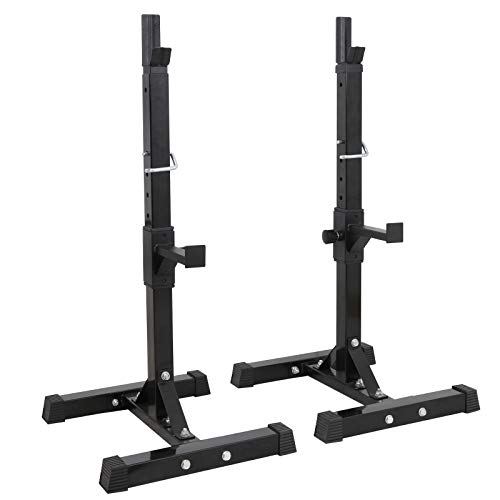
Five compact squat racks compared on footprint, adjustment range and shipping weight, from an 18.5 lb pair of stands to a 115 lb half cage with plate storage.

By Mckinley BirdUpdated 16 min read
On this page
- Best compact squat rack for women at a glance
- How I screened these five racks and who each one fits
- Which spec actually decides a compact squat rack?
- 1. F2C Max Load 550Lbs Pair of Adjustable Squat Rack 41"-66" — Best overall
- 2. YYJO Adjustable Squat Rack — Best upgrade
- 3. Yaheetech Adjustable Squat Rack Pair — Most versatile
- 4. SunHome Power Cage Squat Rack — Best warranty
- 5. PASYOU Adjustable Squat Power Rack for Home Gym — Best premium
- Does a squat rack marketed to women differ at all?
- How much floor space does each pick really take?
- What the listings do not tell you
- The verdict
- FAQ
The best compact squat rack for women, judged on floor space alone, is the F2C adjustable pair: two posts on a 17.7 x 20.1 in footprint, 18.5 lb total, adjusting from 41 to 66 in. If you're short and lifting under a low ceiling, the YYJO rack tops out at 57 in and narrows to a 25 in stance, which suits that build better.
Here's the thing most buyers get wrong. They shop by weight capacity, and every rack in this set clears what a home lifter will ever load. The number that actually splits this field is the bar-height range, because a post that won't drop below your shoulders is useless no matter how much steel it holds.
Best compact squat rack for women at a glance
| Pick | Height range | Footprint | Price |
|---|---|---|---|
| 41-66 in 13 spotter positions |
17.7 x 20.1 in 18.5 lb |
Check Price | |
Best upgrade YYJO Adjustable Squat Rack |
43-57 in claim 8 height levels |
20.9 x 25 in width to 44.5 in |
Check Price |
Most versatile Yaheetech Adjustable Squat Rack Pair |
44-70 in claim 14 pins per post |
21.5 x 19.9 in 40.8 lb |
Check Price |
Best warranty SunHome Power Cage Squat Rack |
28 J-hook positions 84.9 in tall |
46.9 x 42.4 in 115 lb |
Check Price |
Best premium PASYOU Adjustable Squat Power Rack |
Adjustable, range not listed | 36 x 43 in 63 lb |
Check Price |


How I screened these five racks and who each one fits
I worked backwards from buyer profiles rather than from steel gauge. Five racks, five different people.
The apartment lifter who has to stack the rack in a closet on Sunday night needs the lightest posts with the smallest base. That's one profile. The lifter at 5'2" who racks a bar at chest height and never presses overhead needs a low minimum and a narrow stance, which is a different profile again. Somebody at 5'10" needs the opposite: a post that reaches past 66 in.
Then there are the two people who aren't moving anything. One wants plates off the floor and a frame that will still be square in five years. The other wants raw load capacity and doesn't care what it weighs.
I compared the published specifications side by side and ranked on how well each rack serves its profile, not on which is objectively strongest. Here's what that filtering looked like in order:
- Footprint and shipping weight, since a compact squat rack that can't be shifted isn't compact in an apartment.
- Published bar-height range, checked against the reach of a shorter and a taller lifter.
- Adjustment granularity: how many positions, and how far apart.
- What each listing publishes at all. Two of these five give a full height range in numbers. One gives none.
That last point cut more than anything else. A rack that won't tell you how low its J-hooks go is asking you to gamble.
Which spec actually decides a compact squat rack?
Load capacity is the headline on every one of these listings, and it's the least useful number here. The claims run from 441 lb on the Yaheetech to 2400 lb total on the PASYOU. A woman squatting 185 lb has enormous margin on all five.
The spec that decides it is the low end of the bar-height range, paired with the stance width.
Think about the movement. You unrack a squat with the bar sitting just below the top of your shoulders. Get that height wrong on the high side and you're on tiptoes at the most dangerous moment of the lift. Get it wrong on the low side and you're doing a quarter squat just to lift the bar off the hooks.
- F2C: 41 in at the bottom of its range, in 13 steps per post.
- YYJO: 43 in claimed minimum, 8 height levels, plus 10 width settings from 25 to 44.5 in.
- Yaheetech: 44 in claimed minimum, 14 pins per post at roughly 2 in spacing.
- SunHome and PASYOU: position counts published, height ranges not.
Stance width matters almost as much and nobody talks about it. A pair of independent posts lets you set them wherever your feet actually go. A welded cage decides for you. The YYJO splits the difference with an adjustable-width frame, which is the reason it ranks second here.
1. F2C Max Load 550Lbs Pair of Adjustable Squat Rack 41"-66" — Best overall
The smallest, lightest, cheapest rack in this set is also the one with the widest published height range, which is a rare combination.
Best for: lifters who need the rack out of the way between sessions Skip it if: you want a single connected frame rather than two separate posts
Two numbers make the case. The base measures 17.7 x 20.1 in per post, and the pair weighs 18.5 lb. That's the lightest thing here by a wide margin, roughly a third of the PASYOU's 63 lb and a sixth of the SunHome's 115 lb. You can carry one post in each hand.
The height range is 41 to 66 in across 13 spotter positions per side. That 41 in floor is the lowest published figure in this set, which matters if you're setting a bar below shoulder height for a shorter lifter. It reaches 66 in at the top, so a taller partner isn't shut out either.
F2C describes 50 x 50 x 1.5 mm steel tubing and an H-style base, and rates the pair at 550 lb. The listing also mentions thick anti-skid rubber pads for concrete, tile, wood and vinyl.
The trade-off against the two cages here is real. Independent posts have no top crossmember and no built-in spotter cage, so a failed rep drops onto the spotter arms rather than into a frame. You also have to reset both posts every time you change the height, twice the fiddling of a single-frame rack. And only one seller lists it, which is worth knowing.
Pros:
- Lightest pick at 18.5 lb for the pair
- Lowest published minimum height at 41 in
- Smallest footprint per post, 17.7 x 20.1 in
- 13 spotter positions per side for fine height steps
- Cheapest of the five
Cons:
- Two separate posts must be aligned and reset each time
- No enclosed cage or top crossmember for failed reps
- Lowest stated load rating in the set at 550 lb
- Only one seller stocks it
- No published warranty
2. YYJO Adjustable Squat Rack — Best upgrade
The only rack here that adjusts in width as well as height, which makes it the pick for a narrow stance under a low ceiling.
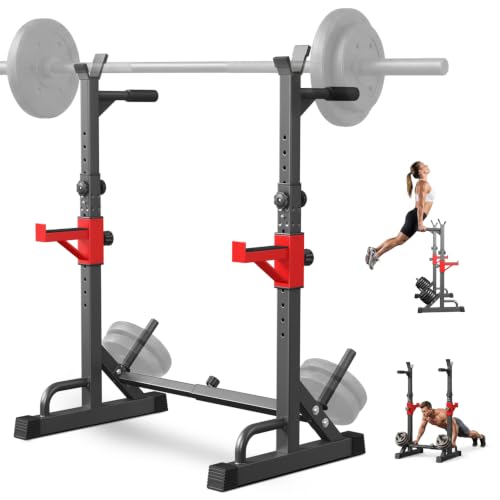
Best for: shorter lifters and narrow stances under a low ceiling Skip it if: you press overhead or need bar heights above 57 in
This one sits at 43 x 20.9 x 25 in and takes the middle price position of the five. What separates it is dual adjustment. YYJO states 8 height levels from 43 to 57 in and 10 width settings from 25 to 44.5 in, which no other pick in this set offers.
Width adjustment sounds like a minor feature until you squat. Narrow your posts to 25 in and the uprights sit inside your foot placement rather than beside it, so you're not stepping around steel to get under the bar. Widen to 44.5 in and it accommodates a full Olympic bar with plates loaded. The brand also lists a 6-position safety bumper as a resting spot between sets, a 650 lb frame rating and thickened steel with anti-rust powder coating.
The 57 in ceiling on bar height is the cost. That's 9 in lower than the F2C and 13 in lower than the Yaheetech's claim, so overhead pressing off the rack is out and a taller lifter will find the top position low for a back squat.
Two other gaps: YYJO publishes no weight for this rack, so you cannot judge how easily it moves, and no warranty term appears on the listing.
Pros:
- Only pick with adjustable width, 25 to 44.5 in
- 8 height levels for stance-specific setup
- 650 lb frame claim with anti-rust powder coating
- Compact 43 x 20.9 x 25 in body
- Mid-range price for two adjustment axes
Cons:
- Height stops at 57 in, lowest ceiling here
- No shipping weight published
- No stated warranty
- Only one seller lists it
- 8 height steps is the coarsest granularity in the set
3. Yaheetech Adjustable Squat Rack Pair — Most versatile
The widest published height range of any pick here, reaching 70 in, so it fits a household with lifters of very different sizes.
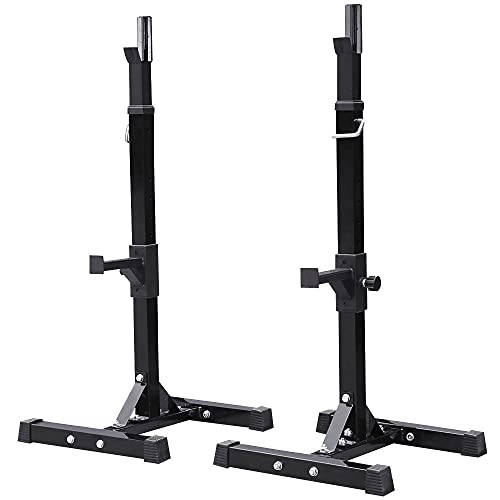
Best for: taller lifters who need bar heights up to 70 in Skip it if: you move the posts daily and want the lightest option
Yaheetech states a 44 to 70 in adjustment range with 14 safety pins per post at 5 cm gaps. That 70 in top end is the highest published figure in this set, and the 5 cm spacing gives you the finest steps of any pick. If one person squats at 48 in and another needs 62 in, this handles both without compromise.
The posts measure 21.5 x 19.9 in at the base with a 66 in overall height, and the pair weighs 40.8 lb. That's heavier than the F2C by more than double, though still light enough to shift a post at a time. Yaheetech describes a 50 mm heavy-duty steel tube frame, a 441 lb maximum load, anti-skid foot pads, and metal nuts with washers that need a wrench to tighten.
Two things pull it below the F2C. The 44 in minimum is 3 in higher, which sounds trivial until you're a shorter lifter reaching for the bar. And 441 lb is the lowest capacity claim of the five, half what the YYJO states.
It is the second-cheapest pick here, and it sells faster than the YYJO, SunHome and PASYOU. Its trade-off against the cages is the same as the F2C's: no enclosed frame, no plate storage.
Pros:
- Highest published reach at 70 in
- 14 pins per post at 5 cm gaps, finest adjustment here
- Second-cheapest of the five
- Small 21.5 x 19.9 in base per post
- Sells faster than three of the other picks
Cons:
- 441 lb load claim is the lowest in the set
- 44 in minimum height is 3 in above the F2C
- 40.8 lb is more than double the F2C's weight
- Nuts require a wrench, so height changes are slow
- No stated warranty
4. SunHome Power Cage Squat Rack — Best warranty
The only pick in this set with a published warranty, and the only one that stores your plates and bar off the floor.

Best for: a permanent garage or basement setup with plates to store Skip it if: the rack has to share space with a car or a bed
Only one listing in this comparison publishes a warranty term, and it is this one: 1 year. That is a meaningful separation when the other four say nothing about coverage at all.
It's a half cage rather than a pair of posts, measuring 84.9 x 46.9 x 42.4 in and weighing 115 lb. SunHome lists 28 adjustable positions for the J-hooks and spotter arms, a 1500 lb rack capacity, a 660 lb bench capacity, four weight plate storage posts, two barbell hooks and dip handles. Everything lives on the frame, which is genuinely useful when the alternative is plates stacked against a wall.
Call the footprint honestly. At 46.9 x 42.4 in it covers more than twice the floor area of an F2C post pair, and at nearly 85 in tall it needs real ceiling clearance. This is the least compact pick in the guide, and it is here for the buyer who has a dedicated corner rather than a shared room.
It's also the slowest seller of the five and sits in the upper price bracket. The 115 lb build means it is assembled once and stays put.
Pros:
- Only pick with a published warranty, 1 year
- 28 J-hook and spotter positions, most in this set
- Four plate posts and two bar hooks built in
- Dip handles add a pulling and pressing station
- 1500 lb rack and 660 lb bench claims
Cons:
- Largest footprint here at 46.9 x 42.4 in
- 84.9 in height demands ceiling clearance
- 115 lb makes relocation a two-person job
- No published bar-height range in inches
- Slowest seller of the five
5. PASYOU Adjustable Squat Power Rack for Home Gym — Best premium
The highest load claim in this comparison by a factor of four, aimed at a lifter who has outgrown a pair of stands.

Best for: heavy loads and a rack that never gets moved Skip it if: you need published bar-height numbers before buying
PASYOU claims 2400 lb total capacity including 1800 lb on the uprights, built from reinforced alloy steel. That's the biggest number in this set by a long way, more than four times the F2C's 550 lb. The frame measures 58 x 36 x 43 in and weighs 63 lb, so it's mid-weight here: heavier than both post pairs, roughly half the SunHome.
It's the most expensive pick in this guide, and the finished silver frame is the only non-black rack in the set. PASYOU lists squats, bench presses, push-ups and dips as supported movements, and describes adjustable height for different users and bar positions.
That last claim is where it loses ground. The listing says the height adjusts but never says between what and what. Every buying decision in this category turns on the minimum and maximum bar height, and here you cannot check either before it arrives. The F2C and Yaheetech both publish the full range in inches.
So this is the pick for someone whose priority is raw capacity and who is comfortable buying on a claim rather than a figure. Against the SunHome it costs more, weighs less, and gives up the plate storage, the dip handles and the 1 year warranty.
Pros:
- Highest capacity claim in the set, 2400 lb total
- 1800 lb upright claim for heavy squats
- 63 lb, roughly half the SunHome's mass
- Supports dips and push-ups alongside barbell work
- Several sellers stock it
Cons:
- No published height range in inches
- Most expensive pick in this comparison
- No plate or bar storage on the frame
- No stated warranty
- 36 x 43 in base is far larger than either post pair
Does a squat rack marketed to women differ at all?
No, and it's worth being straight about that. Nothing in these five listings is designed, sized or specified for women specifically. There is no women's model, no separate size run, no adjusted grip diameter. Amazon returns general-purpose racks for this search.
What changes is which specification you weight most heavily. The average woman is shorter than the average man, so the minimum bar height stops being a footnote and becomes the number that decides the purchase. Same with stance width and with shipping weight, if you're the one carrying the thing up a flight of stairs.
That means judging fit yourself rather than trusting a label:
- Measure from the floor to just below the top of your shoulder. That's your squat unrack height.
- Compare it against the published minimum: 41 in on the F2C, 43 in claimed on the YYJO, 44 in claimed on the Yaheetech.
- If your figure is below the rack's minimum, no amount of steel rating fixes it.
- Check the maximum too, if anyone taller shares the equipment.
How much floor space does each pick really take?
Footprint is where the compact claim gets tested, and the spread across these five is enormous.
The F2C posts occupy 17.7 x 20.1 in each. The Yaheetech posts are 21.5 x 19.9 in each. Both are pairs, so you're placing two small bases rather than one big one, and between sessions you can slide them into a corner or a closet. The YYJO frame is 20.9 x 25 in and widens to 44.5 in when set for a loaded bar.
Then the jump. PASYOU is 36 x 43 in. SunHome is 46.9 x 42.4 in and stands 84.9 in tall. Those two are furniture.
Ceiling height is the trap nobody checks. A standard basement runs about 84 in of clearance, which is under the SunHome's 84.9 in listed height. Measure before you order, not after.
Weight tells you the same story from another angle. 18.5 lb for the F2C pair, 40.8 lb for the Yaheetech pair, 63 lb for the PASYOU, 115 lb for the SunHome. If the room does double duty as a bedroom or a garage, the first two numbers are the only ones that work.
What the listings do not tell you
Reading these five listings side by side, the gaps are consistent enough to be worth naming.
Four of the five publish no warranty at all. Only the SunHome states a term, 1 year. That absence is not proof of a bad rack, but it does mean you have no stated recourse if a weld fails in month 14.
Assembly time appears nowhere. A 115 lb half cage with four plate posts, dip handles and 28 pin positions is not a fifteen-minute build, and neither PASYOU nor SunHome says how long to allow or how many people it takes.
Two picks skip the height range entirely. PASYOU says "adjustable height" without numbers. SunHome gives 28 positions without saying what heights they cover.
And none of the five publishes the internal width between uprights on the cage models, or the J-hook depth. Those figures decide whether a specific Olympic bar racks cleanly. If that matters to your bar, the F2C and Yaheetech avoid the question entirely by using independent posts you position yourself.
The verdict
Think of this best compact squat rack for women comparison in three tiers.
At the entry tier, the F2C pair wins and wins clearly. It is the cheapest here, the lightest at 18.5 lb, the smallest per post at 17.7 x 20.1 in, and it publishes the widest usable height range of any pick: 41 to 66 in across 13 positions. Nothing else in this set combines the lowest bar height with the smallest footprint. The Yaheetech sits alongside it and takes the win for anyone taller, since its claimed 70 in ceiling is 4 in above the F2C's and its 5 cm pin spacing is the finest here.
The middle tier belongs to the YYJO. What the extra outlay buys is the second adjustment axis: 10 width settings from 25 to 44.5 in, which no other pick offers. That's the one to pick if a narrow stance and a 57 in ceiling suit you better than reach.
At the premium tier, you're buying permanence rather than compactness. The SunHome brings the only published warranty in the guide, 1 year, plus four plate posts and dip handles, at the cost of a 46.9 x 42.4 in footprint. PASYOU brings the biggest capacity claim at 2400 lb total but publishes no height range, which is a real gap at the top price in this set.
FAQ
Is a compact squat rack worth it over a bench and dumbbells?
A compact squat rack is worth it the moment you want to load a barbell past what you can clean to your shoulders. Dumbbells cap out fast on squats. The F2C pair adds that capability on a 17.7 x 20.1 in footprint per post and 18.5 lb total, so the space cost is genuinely small compared with a full cage.
Which is the better value pick in this comparison?
The better value pick here is the F2C pair. It's the cheapest of the five and still publishes the lowest minimum bar height at 41 in, the smallest footprint, and 13 spotter positions per post. The Yaheetech is second-cheapest and adds reach to a claimed 70 in with 14 pins per post, so it's the value choice for taller lifters.
What height should a squat rack be set to for a shorter lifter?
Set squat rack height so the bar sits just below the top of your shoulders when you stand upright. Measure that distance from the floor before ordering. Compare it against the published minimums: 41 in on the F2C, 43 in claimed on the YYJO, 44 in claimed on the Yaheetech. If your figure falls below a rack's floor, that rack won't work.
F2C or YYJO: which compact squat rack for women fits a small room better?
Between the F2C and YYJO, the F2C fits a small room better on raw numbers: 17.7 x 20.1 in per post and 18.5 lb, versus a 20.9 x 25 in frame with no published weight. The YYJO wins on adjustability instead, with 10 width settings from 25 to 44.5 in against the F2C's fixed post spacing you set manually.
What mistake do first-time squat rack buyers make most often?
The most common mistake is shopping on load capacity. These five racks claim 441 lb to 2400 lb, and every one of those figures exceeds what a home lifter will load. Ceiling clearance and minimum bar height get ignored instead, which is how a 84.9 in half cage ends up in a basement with 84 in of headroom.
Measure two things before you order anything from this list: the floor-to-shoulder height where you squat, and the clearance above that spot. Those two numbers eliminate most of this field for most rooms, and they matter more than any capacity claim on the page. If both come back tight, the F2C pair is the safe default. It publishes the lowest bar height at 41 in, occupies less floor than anything else here, and at 18.5 lb it goes back in a closet when you're done, which is the whole point of a rack in a room that has another job.